
Volume Swell and Fluid Immersion Testing: How Fluids Change O-Ring Size
What ASTM D471 / ISO 1817 volume swell means for O-Rings: fluid immersion method, ΔV% and hardness change, static vs dynamic limits, IRM oil rankings by elastomer family, and how seal engineers read the datasheet.
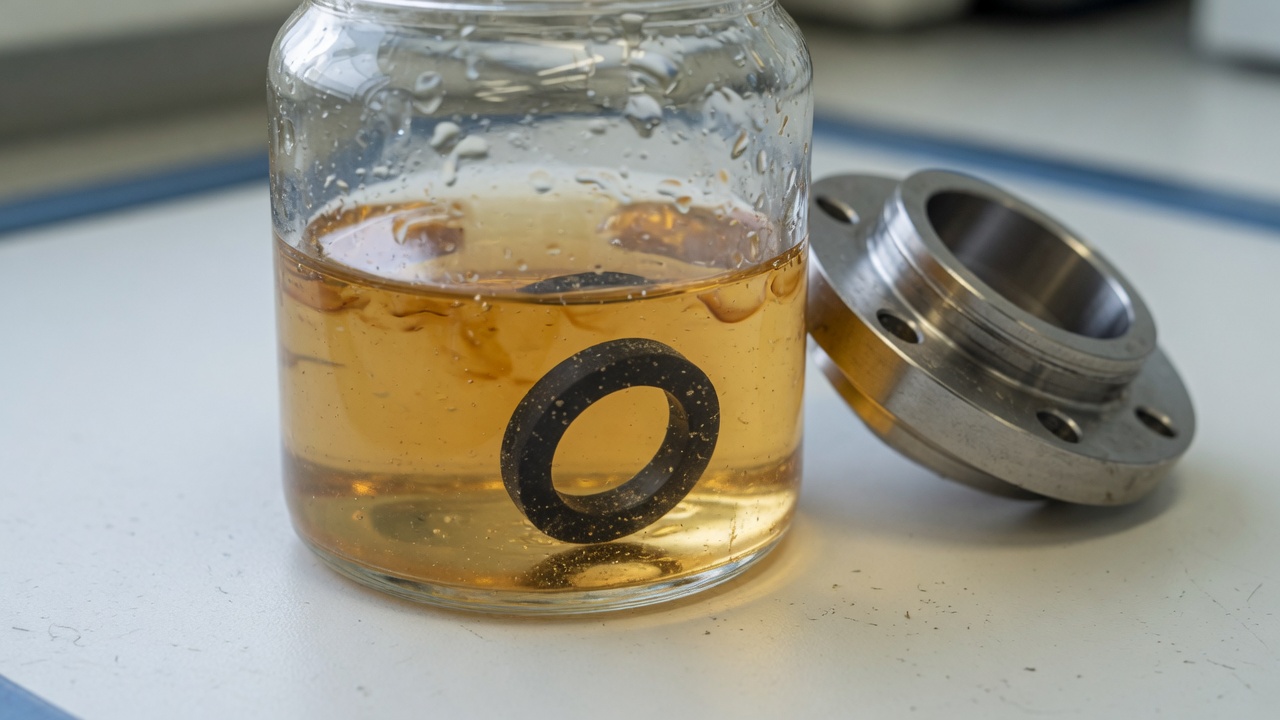
Volume swell is the fluid number that predicts whether an O-Ring will still fit its gland after living in oil, fuel, or process chemistry. ASTM D471 and ISO 1817 immerse rubber in a chosen liquid at a stated temperature and time, then measure how much volume, hardness, and tensile properties moved.
A modest swell can help a static seal keep contact after compression set. A large swell softens the cord, fills the groove past safe gland fill, and invites extrusion. Shrinkage pulls plasticizers out, hardens the ring, and opens a leak path even when the metal never moved.
This article pairs with the chemical swell failure mode, the Chemical Compatibility matrix, and compression set testing. Here the focus is the lab method, how to read ΔV%, and how seal engineers use immersion data.
Chemical Compatibility Compression Set Failure Modes Ask About a Compound
Why volume change matters for seals
An O-Ring seals because elastic contact stress presses rubber into the gland surfaces. Fluid immersion changes that story in three coupled ways:
- Size: the cord grows or shrinks, so groove fill and squeeze shift.
- Hardness / modulus: swell usually softens; shrinkage usually hardens.
- Strength: tensile and elongation often fall when the network absorbs solvent or loses extractables.
When swell climbs too far:
- The ring can jam the cover, spit out of an open groove, or extrude into the clearance gap.
- Softening lowers extrusion resistance even when the dry-heat hardness looked fine.
- A dynamic rod seal can drag, chatter, or wear faster.
When the rubber shrinks:
- Contact stress falls as the cord pulls away from the sealing surfaces.
- Hardness rises and the ring can crack on flex.
- Teardown shows a smaller, often shiny or embrittled cord.
Immersion data is a fluid + temperature + time story. Pair it with compression set when the gland sees both heat soak and chemistry, and with the compatibility chart for a first family screen.
What volume swell is
Volume swell (also written volume change, ΔV, or % swell) is the percent change in specimen volume after immersion in a liquid under ASTM D471 (and the closely related ISO 1817). Labs also report mass change, hardness change, and tensile / elongation retention on the same immersion set.
In plain language: put rubber in the fluid, wait, then ask how big it got and how soft it became.
| Reading | What it means |
|---|---|
| ΔV > 0 | Swell: the network absorbed liquid and grew |
| ΔV < 0 | Shrinkage: extractables left faster than liquid entered (or the fluid attacked fillers / plasticizers) |
| Typical seal screens | Aim for modest ΔV with limited hardness loss; exact limits follow duty |
Two ideas get confused on datasheets:
| Term | What it answers |
|---|---|
| Volume change (ΔV%) | How much free specimen size moved after immersion |
| Mass change (Δm%) | Net weight gain or loss (absorbed fluid minus extractables) |
ΔV is the gland-fill number. Δm helps explain whether the rubber took on fluid, lost plasticizer, or both. Swell almost always pairs with a hardness drop. Shrinkage almost always pairs with a hardness rise.
Volume change in one picture
Original volume V0, immersed volume Vi. Positive ΔV means swell; negative ΔV means shrink. Softness usually tracks the swell direction.
How the volume swell test works
ASTM D471 covers the effect of liquids on vulcanized rubber. ISO 1817 is the common international counterpart. Seal-compound datasheets most often cite immersion in a reference oil, a reference fuel, water, or the customer process fluid. Always read the fluid identity, temperature, and hours on the report.
Volume swell test sequence
Typical ASTM D471 / ISO 1817 immersion workflow. Exact fluid, time, and temperature belong on the datasheet line.
- 1 Measure dry Record original mass and volume (often by water displacement). Note hardness and tensile if those will be reported.
- 2 Immerse Place specimens fully in the test liquid with enough fluid volume so extractables do not saturate the bath.
- 3 Age Hold for the stated hours at the stated °C (commonly 22 h, 70 h, or 168 h).
- 4 Blot & remeasure Remove, blot surface liquid, and remeasure volume, mass, hardness, and tensile properties promptly.
- 5 Calculate ΔV% % ΔV = (Vi − V0) / V0 × 100. Report fluid, hours, and temperature beside the number.
Specimen notes (typical practice)
- Die-cut slabs or tensile dumbbells from a cured sheet are the usual laboratory path.
- Volume-only buttons (for example about 25 mm diameter × 12.5 mm) are common when tensile retention is not required.
- Finished O-Ring sections can be immersed when you want data closer to seal geometry. Smaller cross-sections often show higher percent swell than thick slabs in the same fluid.
- Run at least three specimens per condition and average.
- Keep fluid volume large relative to specimen surface area so dissolved extractables do not change the bath chemistry mid-test.
- After long immersion, some compounds that looked swollen at 70 h shrink once plasticizers finish leaving. Short-term ΔV can be an interim reading, not the stabilized field size.
Reference liquids you will see on datasheets
| Liquid family | What it screens | Notes |
|---|---|---|
| IRM 901 | Low-swell petroleum oil | Milder aromatic content; often mild ΔV on oil-resistant grades |
| IRM 902 | Medium-swell oil | Mid severity between 901 and 903 |
| IRM 903 | High-swell petroleum oil | Classic severe oil screen (legacy ASTM Oil No. 3 role) |
| Reference Fuels A–D | Gasoline-like blends | Fuel C (50/50 isooctane/toluene) is a common aggressive fuel callout |
| Customer process fluid | Real duty chemistry | Best proof when the fluid is known and available |
Aniline point is a useful oil severity hint: lower aniline point oils tend to swell hydrocarbon elastomers more. IRM oils span that range so compounds can be ranked on a shared yardstick.
How seal engineers use volume swell in practice
Industry practice for O-Rings and similar compression seals:
Duty reading of volume swell
Static glands tolerate more ΔV than dynamic glands. Softening and gland fill still set the ceiling in both cases.
Up to about 30% ΔV often workable
Flanges, covers, and lids with room in the groove can live with moderate swell. Modest swell can even offset some compression set. Watch hardness drop and overfill when pressure is high.
About 10–15% ΔV as a practical ceiling
Rods, shafts, and rotary lips leave less room for growth. Extra swell raises friction, wear, and extrusion risk unless the gland was designed for it.
Set offset
If a seal relaxes about 15% and swells about 20%, contact can stay alive longer than dry-heat set alone predicts. Treat that as a bonus, not a selection strategy.
Overfill & soft cord
Groove volume runs out. Soft rubber extrudes into the gap. Teardown shows a gummy, oversized ring. See chemical swell.
Lost contact
Plasticizer extraction hardens and shrinks the cord. Squeeze falls. The gland looks empty relative to the original ring.
Catalog check: Compare ΔV numbers only when fluid, hours, and temperature match. A “+12%” in IRM 901 at 70 °C is not the same claim as +12% in IRM 903 at 150 °C, or in the customer hydraulic oil.
Design takeaways
- Start with the compatibility matrix, then confirm with D471 / ISO 1817 data in the real fluid when the duty is critical.
- Budget gland void for thermal growth plus fluid swell. Typical assembled fill leaves headroom for both.
- Softening from swell lowers extrusion resistance. Raise hardness or add backup rings when ΔV and pressure both climb.
- After teardown, a soft oversized ring or a hard undersized ring is field evidence of fluid attack. Pair with compression set when a permanent flat also appears.
Typical volume swell by elastomer family
The chart below shows approximate commercial midpoints for a severe petroleum-oil style screen (illustrative ranking near an IRM 903 immersion). Shorter bars mean lower (better) ΔV in oil. Real grades scatter with ACN level, fluorine content, cure system, and exact hours / °C. Always use the grade datasheet.
Typical ΔV in high-swell reference oil (illustrative)
Approximate midpoints on a 0–150% swell scale for a severe petroleum oil screen. Color: green (low swell) → amber → red (high swell). Water and polar fluids rank families differently.
Width % ≈ typical ΔV ÷ 150 on a 0–150% scale. EPDM and silicone excel in many polar / water duties and look poor on this petroleum-oil ranking. Use grade datasheet values in your fluid.
| Family | Typical ΔV midpoint (oil screen) | Sealing notes |
|---|---|---|
| FFKM | ~1% | Premium chemical resistance; confirm grade and cost |
| FKM | ~2–5% | Strong hot-oil and fuel resistance in most grades |
| NBR (high ACN) | ~5% | Best nitrile oil resistance; colder TR-10 suffers as ACN rises |
| HNBR | ~12% | Oil resistance near NBR with better heat and strength |
| NBR (medium ACN) | ~10–15% | Everyday oil service balance of swell and low-temp flexibility |
| Fluorosilicone | ~15% | Fuel / oil capability where silicone alone swells too far |
| Neoprene (CR) | ~45% | Fair oil resistance; confirm against the real fluid |
| Silicone (VMQ) | ~60% | Poor petroleum-oil ranking; strong in dry heat and many polar fluids |
| EPDM | ~135% | Wrong for petroleum oil; excellent in water, steam, and many brake fluids |
Shop starting points when oil or fuel immersion drives the choice: Viton® / FKM, Nitrile (Buna-N), HNBR, and EPDM when the fluid is water, steam, or polar chemistry instead of petroleum oil.
ACN level inside nitrile
Nitrile is not one swell number. Higher acrylonitrile (ACN) content lowers petroleum-oil ΔV and raises the low-temperature floor. Medium-ACN seal grades are the everyday compromise. Low-ACN grades flex colder and swell more in oil. When two nitrile datasheets disagree in IRM 903, check the ACN band before you blame the lab.
Volume swell compared with related tests
| Test | What it measures | When seal engineers reach for it |
|---|---|---|
| Volume swell (ASTM D471 / ISO 1817) | Fluid-driven size, hardness, and tensile change | Primary oil / fuel / chemical immersion screen |
| Chemical compatibility chart | Family-level recommend / avoid ratings | Fast shortlist before lab immersion |
| Compression set (ASTM D395) | Permanent thickness loss after dry (or fluid-aged) squeeze | Long-dwell sealing-force retention |
| Heat aging (ASTM D573 / ISO 188) | Hardness / tensile shift after oven aging | Heat damage without a liquid present |
| Hardness (Shore A / IRHD) | Indentation hardness before and after immersion | Quantifies softening or hardening from the fluid |
| TR-10 (ASTM D1329) | Cold retraction temperature | Cold start floors after a fluid-compatible compound is chosen |
Reading a datasheet without getting fooled
- Find % volume change (or ΔV), then read fluid, hours, and temperature.
- Read hardness change beside ΔV. Large swell with a big Shore drop is a softer, weaker cord in the gland.
- Check tensile and elongation retention when extrusion or dynamic wear matters.
- Confirm whether the fluid is a reference oil / fuel or the actual process media.
- Ask whether the reported value is a short immersion or a longer stabilized reading.
- Compare only like-with-like across candidate grades.
Application trap: A low ΔV in IRM 901 does not prove the compound for aromatic solvents, brake fluid, or amines. Re-match the fluid chemistry. Use the compatibility matrix and, for critical glands, immerse in the real media.
Practical selection checklist
- Write down the fluid (or fluid family), max temperature, immersion / exposure time, and static vs dynamic duty.
- Shortlist families on the Chemical Compatibility chart.
- Compare volume swell on matching fluid / hours / °C, plus hardness change.
- Check compression set at a temperature near the soak.
- For cold starts, add TR-10.
- Validate critical glands with the real compound, squeeze, and fluid. Datasheet ΔV is a screen, not a full life proof.
Quick answers
What does volume swell mean?
It is the percent change in rubber volume after immersion in a liquid at a stated time and
temperature. Positive ΔV is growth (swell). Negative ΔV is shrinkage. Report the
fluid and condition beside every number.
Is 20% swell acceptable?
For many static closed grooves, about 20–30% can be workable if hardness loss stays
moderate and gland void remains. For dynamic seals, about 10–15% is a common practical
ceiling unless the gland was designed for more. High pressure tightens both limits.
Why did my O-Ring come out soft and oversized?
Incompatible fluid absorption is the usual cause. Petroleum oil in EPDM and brake fluid in
nitrile are classic mismatches. See
chemical swell in failure modes.
Why did my O-Ring shrink and harden?
Plasticizer or additive extraction into the fluid, or chemical attack that removes mass
from the network. Shrinkage loses squeeze even when the groove dimensions never changed.
Should I trust a 70-hour IRM 903 number for field life?
It is an excellent ranking tool across compounds. Field size can still drift after
longer immersion as extractables leave. For critical duties, run longer immersions in the
actual fluid and inspect hardness and tensile, not ΔV alone.
Does swell fix compression set?
Modest swell can offset some set and keep contact alive. Relying on large swell to rescue a
high-set compound is a poor strategy: softening and overfill show up as extrusion and jam
risks. Design for low set and compatible ΔV together.
Volume change values vary by compound, fluid, cure, and test condition. Use grade-specific data in the service fluid for design decisions.
