SAE J1926 ORB Boss O-Rings: AS568 900-Series Sizes That Actually Seal the Port
What SAE J1926 O-Ring Boss fittings need from the seal: AS568-901…932 boss O-Rings, how they differ from NPT and JIC, materials, install tips, and a Boss-only size chart.
Jump to the Boss O-Ring size chart ORB Boss Size Chart Open Master O-Ring Size Chart Shop Hydraulic Boss O-Rings Shop OSK™ Boss Seal Kit
This guide explains SAE J1926 ORB ports, the AS568 900-series boss O-Rings that belong in them, how the hardware is described in the field, and how to pick compound and size without confusing ORB with JIC, NPT, or ORFS.
What SAE J1926 / ORB actually is
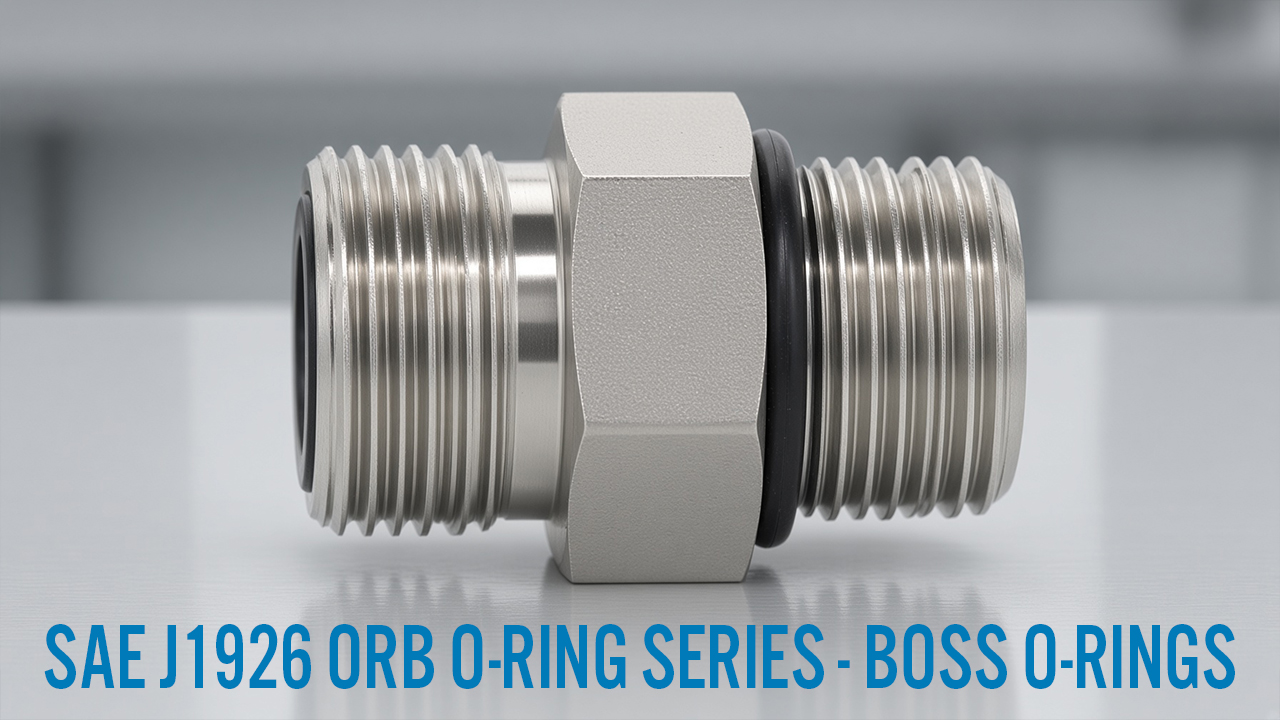
ORB means O-Ring Boss. It is a straight-thread (UN/UNF) port connection where a male stud screws into a female boss and an elastomer O-Ring is compressed into a machined cavity and chamfer in the port.
The controlling inch standard is SAE J1926 (aligned with ISO 11926 for the same inch family):
| Document | What it covers |
|---|---|
| SAE J1926-1 | Female port dimensions (the boss in the pump, valve, cylinder, or manifold) |
| SAE J1926-2 / -3 | Male stud ends (heavy-duty and lighter-duty styles used on adapters and fittings) |
| SAE J514 | Related hydraulic tube fitting geometry that shares the same dash / thread language |
AS568 sizes 901 through 932 are the O-Rings intended for sealing straight-thread tube fittings in a boss. When there is a choice, J1926 port dimensions are preferred over older military AS5202 cavities because the cavity tolerances are tighter and the O-Ring is distorted less on assembly.
You will see the same connection labeled:
- ORB / O-Ring Boss
- SAE straight thread O-Ring
- SAE J1926
- Boss seal / AS568 900-series
Those names point at one sealing system. They are not synonyms for JIC flare, NPT pipe thread, or ORFS face seal.
How the boss O-Ring seals (and why it is not a normal groove)
In a textbook rectangular gland, the O-Ring sits in a square-ish groove and gets radial or axial squeeze. A boss seal is different.
On the male fitting, the O-Ring sits in a groove under the hex (fixed studs) or under the backup washer / locknut stack (adjustable elbows and tees). On the female port, a 45° style chamfered cavity receives that ring. When you torque the fitting, the shoulder (or washer) traps the O-Ring so it takes a diagonal squeeze through the cross-section. The 900-series is built for that geometry, not for a standard AS568 face or piston groove.
That is why a soft 70-duro general-purpose ring of “about the same ID” is a bad substitute. Boss service wants the right AS568-9xx size and, for most petroleum hydraulic oil, a harder compound.
ORB vs NPT vs JIC vs ORFS
Fitting buyers mix these up constantly because dash sizes and UNF threads look familiar across families. Seal location is what matters.
| Connection | Seal method | Thread role | Typical mistake |
|---|---|---|---|
| ORB (SAE J1926) | O-Ring compressed into port chamfer | Straight UN/UNF, clamp only | PTFE tape on the threads; wrong 9xx dash |
| NPT / NPTF | Thread interference (± tape/dope) | Tapered threads are the seal | Forcing NPT into an ORB boss (or vice versa) |
| JIC (SAE J514 37°) | Metal-to-metal flare seat | Straight thread, clamp only | Assuming “same dash thread” means same seal |
| ORFS (SAE J1453) | O-Ring on a flat face | Straight thread, clamp only | Using a boss 9xx ring on an ORFS face (usually an 0xx face ring) |
The field rule is simple: threads hold, the O-Ring seals. If an installer reaches for pipe dope because “that is how ports work,” the assembly is already wrong for J1926. These ports are the preferred industrial hydraulic port connection when you want a reusable elastomeric seal instead of a tapered thread.
The AS568 900-series: boss sizes, not “just another dash”
Standard AS568 face/radial sizes run in the familiar 0xx–4xx bands. Boss seals are the 900-series: roughly AS568-901 through AS568-932, with intentional gaps (there is no everyday -915 or -917 in the catalog list).
Rule of thumb used across size charts:
- Except for the special small -901, the digits after the leading 9 track nominal tube OD in sixteenths of an inch.
- Example: -908 pairs with 1/2″ tube language and a -8 ORB fitting; -916 pairs with 1″ / -16.
Hydraulic mil callouts often land on MS28778 (and related) boss gaskets for many of these dashes. See the handbook mil-spec cross reference when a drawing quotes MS / NAS / AS part numbers instead of plain AS568.
Common ORB port → boss O-Ring map
These are the sizes you see most on pumps, directional valves, cylinders, and filter heads:
| ORB dash | Thread (UN/UNF) | Nom. tube | Boss O-Ring |
|---|---|---|---|
| -4 | 7/16-20 | 1/4″ | AS568-904 |
| -6 | 9/16-18 | 3/8″ | AS568-906 |
| -8 | 3/4-16 | 1/2″ | AS568-908 |
| -10 | 7/8-14 | 5/8″ | AS568-910 |
| -12 | 1-1/16-12 | 3/4″ | AS568-912 |
| -16 | 1-5/16-12 | 1″ | AS568-916 |
| -20 | 1-5/8-12 | 1-1/4″ | AS568-920 |
| -24 | 1-7/8-12 | 1-1/2″ | AS568-924 |
| -32 | 2-1/2-12 | 2″ | AS568-932 |
Full dimensions for all twenty published boss sizes are in the interactive chart below, the ORB Boss Size Chart, and under the ORB Boss chip on the Master O-Ring Size Chart.
Compound and hardness
Catalog practice for SAE ORB boss seals is consistent:
| Compound | Typical hardness | Where it belongs |
|---|---|---|
| Nitrile (NBR / Buna-N) | 90 Shore A | Default for petroleum hydraulic oil on steel ORB fittings |
| FKM (Viton®) | 90 Shore A | Higher temperature, many fuels / aggressive fluids; common stainless ORB option |
| EPDM | ~80 Shore A | Water-glycol / phosphate-ester fluids; do not lube with petroleum grease |
| HNBR | High durometer | Step-up heat and oil resistance when standard NBR is marginal |
SAE/ASTM compound shorthand you will see on boss seals:
- Type CH: Nitrile 90 for petroleum fluids (about −30°F to 250°F)
- Type CA: EPDM 80 for water-based / non-petroleum fluids
- Type HK: Fluorocarbon 90 for broader fluid / higher temperature service
Why 90 duro? The boss chamfer and pressure put extrusion risk on the ring. A soft 70-duro “close enough” seal is one of the most common weep causes on ORB ports. For hydraulic service background, see Industries and the Nitrile / FKM material pages.
Installation notes that prevent callbacks
Assembly guidance for SAE O-Ring Boss fittings converges on the same checklist:
- Clean the port chamfer. Nicks, chips, and vertical tool marks are leak paths.
- Confirm the AS568-9xx size and replace any flat, nicked, or unknown ring.
- Lubricate the O-Ring with clean system fluid (or petrolatum for NBR/FKM). For EPDM, use system fluid only.
- Hand-start until the O-Ring contacts the port, then torque with a wrench to the fitting maker’s wet-torque chart. Do not invent torque from memory across fitting families.
- On adjustable elbows/tees: seat the O-Ring, back off no more than one turn for orientation, hold the body, and tighten the locknut.
Do not put PTFE tape or pipe dope on ORB threads. SAE O-Ring Boss ends are meant to seal with the elastomer, not with thread sealant. Tape blocks proper seating and sheds into the oil.
Torque and working-pressure numbers vary by stud class (J1926/2 vs /3), plating, and fitting design. Always use the wet-torque chart that matches the fitting you are installing.
Common field mistakes
- Using a standard 0xx/1xx/2xx AS568 ring because the ID “looks close.”
- Installing 70 duro when the port expects 90 duro boss stock.
- Threading NPT into an ORB boss (or an ORB stud into a pipe port).
- Treating ORB and JIC as interchangeable because both use straight UNF dashes.
- Confusing ORB with ORFS face seals (different O-Ring family and gland).
- Mixing ISO 6149 metric ports with inch J1926 hardware.
- Omitting the O-Ring, pinching it on a sharp edge, or assembling it dry.
- Over-backing an adjustable fitting past one turn, then wondering why it weeps.
If a boss fitting weeps after “everything threaded fine,” start with seal identity and hardness before you blame the manifold. The troubleshooting note on weep past threads on a boss fitting points the same direction.
Boss O-Ring size chart (AS568 900-series)
Search by CS, ID, dash, fitting size (-8), or thread (3/4-16). Code links open a store search. See also the ORB Boss Size Chart and the ORB Boss chip on the Master O-Ring Size Chart.
| Code | ORB dash | Tube OD | Thread (UN/UNF) | CS (in) | ID (in) | OD (in) | CS (mm) | ID (mm) | OD (mm) |
|---|---|---|---|---|---|---|---|---|---|
| Loading… | |||||||||
Loading chart…
AS568 900-series boss seals for SAE J1926 ORB ports
(AS568-901…932). Threads hold; the O-Ring seals in the port chamfer.
OD is ID + 2×CS. Common hydraulic ports use
-904, -906, -908, -910, -912, and -916.
Code links open a product search on
theoringstore.com.
For the full multi-standard table, open the
Master O-Ring Size Chart and select ORB Boss.
Specifying and buying without ambiguity
A complete callout removes the guessing:
- Port / stud standard: SAE J1926 (ORB), dash size, and male/female.
- Boss O-Ring: AS568-9xx (or the MS / NAS / AS boss equivalent when the print requires it).
- Compound + duro: e.g. NBR 90 for mineral hydraulic oil; FKM 90 for hotter / chemically harder duty.
- Fitting style: fixed stud vs adjustable (NWO / locknut + washer).
We stock hydraulic boss seals and kits for this work; use the shop buttons at the top of the article when you are ready to order.
For measuring an unknown ring before you search, see How to Measure an O-Ring and the Sizing & Standards overview. Metric port sealing is a different standard family: use ISO 6149 on the Master Chart, not J1926 inch ORB sizes.
Bottom line
SAE J1926 ORB is the North American hydraulic port that seals with an AS568 900-series boss O-Ring, not with tapered threads and not with a flare seat. Match the fitting dash to the 9xx seal, use the hardness and compound the fluid demands (usually NBR 90 for petroleum hydraulics), lubricate, torque, and leave the tape in the drawer.