
Rapid Gas Decompression (RGD) Testing for Elastomer O-Rings
What ISO 23936-2 / NORSOK M-710 rapid gas decompression means for O-Rings: high-pressure gas soak, fast depressurization, 0-5 blister ratings, cross-section traps, and how seal engineers pick RGD-resistant compounds.
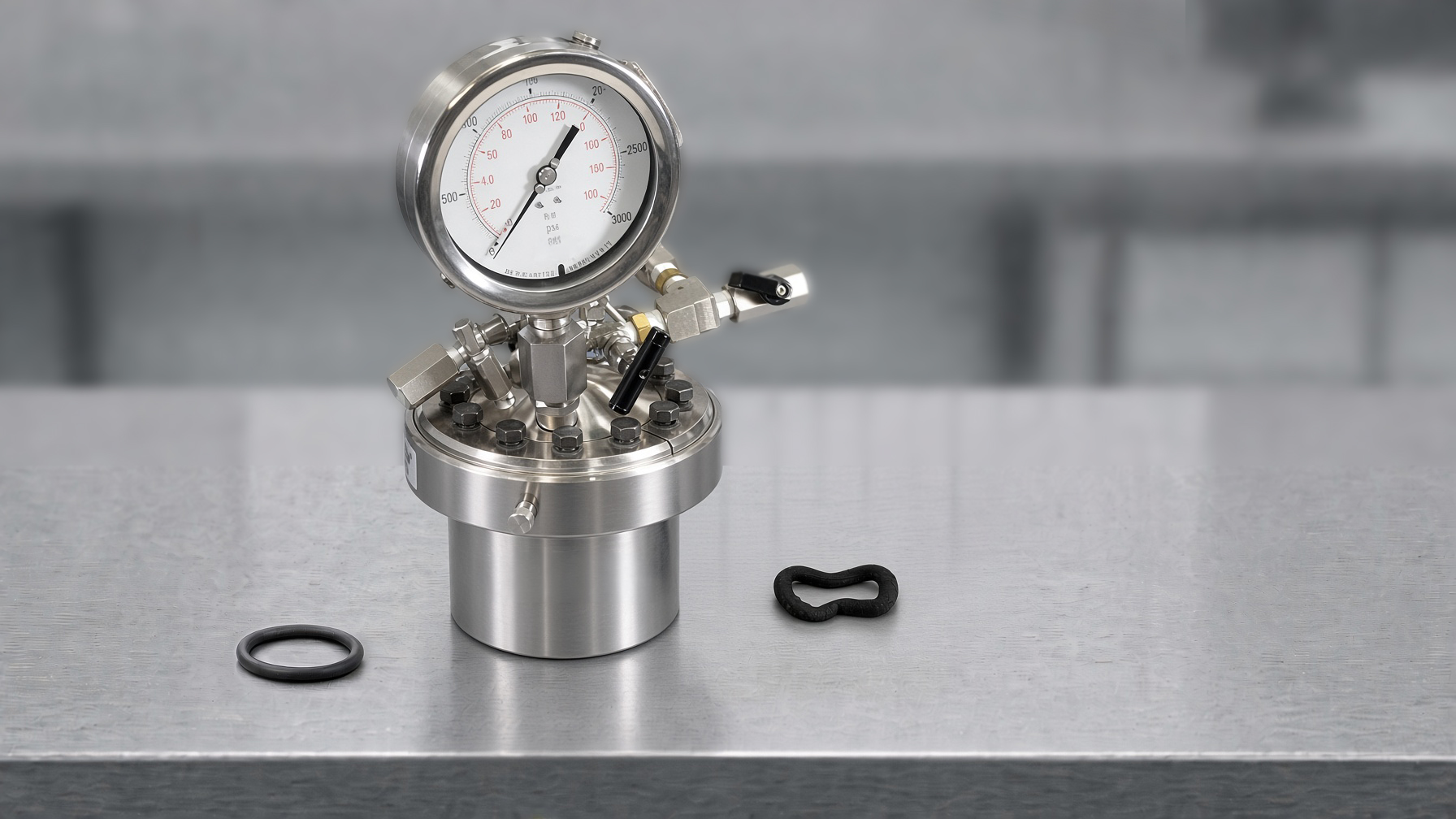
Rapid gas decompression is the high-pressure gas test that predicts whether an O-Ring will blister, crack, or split when system pressure drops fast. Under ISO 23936-2 and NORSOK M-710, finished O-Rings soak in hot, pressurized methane/CO₂, then decompress at a controlled rate through repeated cycles. Labs cut the rings and score internal damage from 0 (clean) to 5 (through-cracks or fragments).
Catalog “RGD resistant” claims usually point at this screen. Some grades publish a perfect 0000 rating. Some pass with visible internal cracks at rating 1-3. Reading the rating, gas mix, pressure, temperature, decompression rate, and cross-section keeps high-pressure gland design honest.
This article pairs with explosive decompression (RGD) failure modes and sits beside volume swell, heat aging, and compression set as the gas-service durability screen.
RGD Failure Mode Material Pages Volume Swell Ask About a Compound
Why rapid gas decompression matters for seals
An O-Ring seals because elastic contact stress presses rubber into the gland. In high-pressure gas service that story gets a second chapter:
- Gas dissolves into the elastomer during a long soak. Permeation and solubility put molecules inside the cord, not only around it.
- Fast depressurization drops external pressure while dissolved gas is still trapped. The gas expands inside the network and drives blisters, pits, cracks, and splits.
- Teardown after a blowdown can show a ring that looks shredded from the inside out even when the groove never moved.
When RGD resistance is short of the duty:
- Valves, Christmas trees, compressors, and downhole tools weep after a planned or unplanned depressurization.
- Internal cracks grow over repeated cycles until the cord fragments.
- A compound that looks fine on dry heat and oil swell still fails the gas blowdown.
RGD is a pressure + gas + temperature + rate + geometry story. Slow the decompression when the process allows it. When the blowdown is fast by design, pick an RGD-qualified grade at the real cross-section and confirm the rating string on the certificate.
What rapid gas decompression testing is
Rapid gas decompression (RGD), also called explosive decompression (ED), is the damage that appears after vulcanized rubber soaks in high-pressure gas and then loses that pressure faster than the gas can diffuse out. Qualification testing under ISO 23936-2 (Annex B) and NORSOK M-710 (Rev. 3 points to the ISO RGD method) cycles finished O-Rings through controlled soaks and depressurizations, then rates internal damage on cut cross-sections.
In plain language: load the seal with gas at high pressure and heat, dump the pressure fast, and ask whether the cord stayed whole.
| Reading | What it means |
|---|---|
| Rating 0 | No internal cracks, holes, or blisters |
| Rating 1-3 | Increasing internal crack counts / lengths (still a standards pass) |
| Rating 4-5 | Severe cracking or through-cracks / fragments (fail) |
| Overall string | Four section scores per ring (for example 0000 or 2110), then a worst-case overall for the set |
Two ideas get confused on datasheets:
| Term | What it answers |
|---|---|
| RGD / ED (ISO 23936-2 / NORSOK M-710) | Whether finished O-Rings survive high-pressure gas soak + fast depressurization without unacceptable internal damage |
| Volume swell (ASTM D471 / ISO 1817) | How much size and property change a fluid causes after immersion |
RGD ranks blowdown survival in gas. Volume swell ranks fluid uptake and softening. Both belong on a high-pressure gas seal datasheet. A compound can look quiet on liquid immersion and still blister on a methane/CO₂ dump.
RGD in one picture
Gas dissolves into the cord at high pressure. Fast depressurization expands that gas inside the elastomer and can open blisters and cracks. Rating comes from cut cross-sections after the cycles.
How the RGD test works
ISO 23936-2 Annex B and NORSOK M-710 qualify elastomer O-Rings for RGD resistance under a deliberately tough, standardized cycle. Exact fixture geometry (gas-trap vs free-flow), squeeze, and groove fill belong on the report. Seal datasheets most often cite a 0-5 section rating string under a stated gas, pressure, temperature, and rate.
RGD test sequence
Typical ISO 23936-2 / NORSOK M-710 workflow on finished O-Rings. Report every condition beside the rating string.
- 1 Fixture O-Rings Mount finished O-Rings (commonly about 5.33 mm cross-section, for example ISO 3601 −312 / −325 class sizes) at a stated squeeze and groove fill.
- 2 Pressurize & soak Charge with the test gas (often 90/10 CH₄/CO₂), hold at the stated bar and °C for the initial soak (commonly on the order of 68-72 h).
- 3 Decompress Drop pressure at a controlled rate (ISO heritage often about 20 bar/min; related NORSOK practice cites 20-40 bar/min), then dwell at ambient.
- 4 Repeat cycles Run the remaining pressure cycles with intermediate soaks (commonly 8 depressurization events in the ISO / NORSOK family of methods).
- 5 Cut & rate Section each ring into four equal radial cuts, examine at ≥10×, and score each cut 0-5. Ratings 4 and 5 fail. Report the four-digit string per ring and the overall worst-case result.
Specimen and fixture notes (typical practice)
- Finished O-Rings are the usual path. The standard screen cross-section is about 5.33 mm (0.210 in). Larger cords are a tougher ask.
- Squeeze near 15% and groove fill near 80-85% are common ISO / NORSOK fixture targets. Confirm the certificate values.
- Run multiple replicates (often three or four rings). Overall rating uses a worst-case reading across sections and replicates.
- Larger-ID rings may require more cuts; the four worst scores still drive the report.
- Fixture style matters: a gas-trap housing holds gas against the seal during dump; a free-flow housing vents more openly. Compare like-with-like across grades.
- Related industry methods (for example TOTAL / SHELL heritage screens) change pressure, CO₂ fraction, temperature, or dump rate. An ISO pass does not automatically equal every operator method.
Typical ISO / NORSOK screen conditions
Typical RGD screen conditions
Common ISO 23936-2 / NORSOK M-710 Annex B family values. Always read the certificate for the exact method edition, fixture, and measured rates.
| Parameter | Typical ISO / NORSOK screen |
|---|---|
| Standards | ISO 23936-2 Annex B; NORSOK M-710 (Rev. 3 → ISO RGD) |
| Specimen | Finished O-Ring, ~5.33 mm CS |
| Gas | 90/10 CH₄ / CO₂ (molar) |
| Temperature | 100 °C (212 °F) |
| Pressure | 150 bar (15 MPa / ~2175 psi) |
| Initial soak | ~68-72 h |
| Decompression rate | ~20 bar/min (related practice 20-40 bar/min) |
| Cycles | 8 depressurization events with ambient dwells |
| Squeeze / fill | ~15% squeeze; ~80-85% groove fill |
| Acceptance | Section ratings 0-3 pass; 4-5 fail |
Cross-section trap: A perfect 0000 at 5.33 mm CS does not prove the same grade at 6.99 mm or thicker cord. Diffusion path length grows with section. Qualify the cord you will install, or treat thicker seals as a separate RGD ask.
How seal engineers use RGD ratings in practice
Industry practice for high-pressure gas O-Rings:
Duty reading of RGD
Fast blowdowns need qualified grades and honest cross-section data. Slow, controlled vents still benefit from RGD awareness when gas soaks are long.
Demand a rated grade
Valves, trees, compressors, and tools that see planned or emergency depressurization need ISO / NORSOK RGD data at your CS. Prefer low section scores (ideally 0000) under conditions at least as tough as the duty.
Still watch gas uptake
A controlled vent reduces peak damage risk, and dissolved gas still loads the cord during long soaks. Pair permeation and swell awareness with a graded RGD compound when CO₂ fraction or temperature is high.
0000
No visible internal damage on any scored section. Highest confidence for repeated blowdowns at the tested CS and conditions.
1-3 scores
Acceptable under NORSOK / ISO rules, and internal cracks already exist. Ask whether your duty cycles are fewer and milder than the screen before you treat a 3333 as equal to a 0000.
4-5 scores
Severe cracking or through-section damage. Field teardown often matches explosive decompression blisters and splits.
Catalog check: Compare RGD claims only when gas mix, pressure, temperature, rate, cycles, squeeze, and CS match. A 0000 at 100 °C / 150 bar / 20 bar/min is not the same claim as a short custom cycle in nitrogen.
Design takeaways
- Write down max gas pressure, CO₂ (or H₂S) fraction, soak temperature, dump rate, and O-Ring cross-section before you shortlist compounds.
- Prefer grades with published ISO 23936-2 / NORSOK M-710 certificates at your CS. Ask for the four-digit strings, not only “pass.”
- Harder, high-modulus RGD grades (often ~90 Shore A in oilfield practice) help resist blister growth. Confirm extrusion gap and gland fill still fit.
- After teardown, internal blisters and splits after a blowdown are classic RGD evidence. See failure modes.
Damage rating scale (0-5)
Labs cut each O-Ring into four equal radial sections and score every cut under magnification. The table below summarizes the ISO / NORSOK heritage criteria used across much of the industry.
RGD section rating scale
Visual criteria on cut cross-sections (≥10×). Ratings 0-3 pass; 4-5 fail. Overall ring performance is reported as a four-digit string.
| Rating | What the cut shows | Result |
|---|---|---|
| 0 | No internal cracks, holes, or blisters of any size | Pass |
| 1 | <4 internal cracks, each <50% of CS; total crack length < CS | Pass |
| 2 | <6 internal cracks, each <50% of CS; total crack length < 2.5× CS | Pass |
| 3 | <9 internal cracks; at most two cracks between 50% and 80% of CS | Pass |
| 4 | >8 internal cracks, or one or more cracks longer than 80% of CS | Fail |
| 5 | Through-cracks across the CS, or the seal separates into fragments | Fail |
Example: section scores 1,1,1,0 report as 1110. Across three replicates 1110 / 3110 / 2220, a worst-case overall near 3220 still passes the standard and already shows damage.
Typical RGD capability by elastomer family
The chart below is an illustrative shortlist ranking of how commercial seal families usually approach high-pressure gas RGD duty. Longer bars mean stronger typical RGD posture when a qualified grade is chosen. Real results are grade-specific. Always use the certificate at your CS, gas, and conditions.
Typical RGD posture by family (qualified grades)
Illustrative ranking for oilfield / HP gas shortlisting. Color: green (stronger RGD grades common) → teal → amber → red (standard grades rarely enough). Individual compounds scatter widely.
Family bars are qualitative shortlist cues only. Design from grade certificates (ISO 23936-2 / NORSOK M-710) at the installed cross-section.
| Family | Typical RGD posture | Notes for seals |
|---|---|---|
| FFKM | Premium when an RGD grade is specified | High heat and chemical ceiling; confirm the exact certificate and cost |
| FKM | Strong in dedicated RGD grades | Common oilfield path; match fluid/sour needs beside the RGD string |
| FEPM / Aflas® | Strong in qualified grades | Steam / amine / sour paths; confirm RGD rating separately |
| HNBR | Strong step up from NBR | Frequent choice for high-pressure and sour-leaning service |
| EPDM | Grade-dependent | Some HP gas grades exist; do not assume general EPDM is RGD-ready |
| NBR | Usually weak for fast HP dumps | Everyday oil seals; escalate to HNBR / FKM / FEPM / FFKM for RGD |
| Silicone | Poor for HP gas RGD | Excellent dry heat elsewhere; wrong family for explosive decompression |
Shop starting points when high-pressure gas and RGD sit beside fluid duty: HNBR, Viton® / FKM, Simriz® FFKM (NORSOK-certified options), and Aflas®.
RGD compared with swell, heat aging, and set
| Test | What it measures | When seal engineers reach for it |
|---|---|---|
| RGD (ISO 23936-2 / NORSOK M-710) | Internal blistering / cracking after HP gas soak + fast dump | Primary blowdown survival screen for gas service |
| Volume swell (ASTM D471 / ISO 1817) | Fluid-driven size and property change | Liquid or mixed-phase chemistry beside the gas |
| Heat aging (ASTM D573 / ISO 188) | Hardness / tensile / elongation shift in hot air | Continuous temperature embrittlement risk |
| Compression set (ASTM D395 / ISO 815) | Permanent thickness loss after fixed squeeze | Long-dwell sealing-force retention |
| TR-10 (ASTM D1329 / ISO 2921) | Cold retraction temperature | Cold start floors after the gas compound is chosen |
For high-pressure gas O-Rings, use RGD + fluid compatibility together. RGD tells you whether the cord survives the dump. Swell and aging tell you whether the compound still looks like rubber in the process fluid and heat band. Add compression set for long-dwell squeeze and TR-10 when the same gland also sees cold starts.
Reading a datasheet without getting fooled
- Find RGD, ED, ISO 23936-2, or NORSOK M-710, then read the rating string (for example 0000), not only the word “pass.”
- Confirm gas mix, pressure, temperature, decompression rate, cycles, squeeze, and cross-section.
- Ask whether the fixture was gas-trap or free-flow.
- Compare only like-with-like across candidate grades.
- If your installed CS is thicker than the certificate CS, treat the published pass as a screen and re-qualify.
- Check volume swell and sour / chemical aging when CO₂, H₂S, or liquid hydrocarbons ride along.
Application trap: A standards pass with section scores of 3 is still damaged rubber. For frequent blowdowns, prefer 0000 (or the lowest available scores) under conditions at least as severe as the duty. Pair that with a realistic dump-rate discussion with operations.
Practical selection checklist
- Write down max gas pressure, gas composition (especially CO₂ / H₂S), soak temperature, expected dump rate, cycle count, and O-Ring cross-section.
- Shortlist families with a real RGD pedigree for the fluid and heat band: HNBR, FKM / Viton®, Aflas®, FFKM.
- Compare ISO 23936-2 / NORSOK M-710 certificates: rating strings, CS, and test conditions.
- Check volume swell and heat aging on matching duties.
- Confirm hardness / modulus still fit the extrusion gap and gland fill.
- Validate critical tools with the real compound, CS, and a dump profile as severe as the field event. A datasheet RGD pass is a screen, not a full life proof.
Quick answers
What does RGD testing mean?
It is a high-pressure gas soak followed by controlled fast depressurization on finished
O-Rings under ISO 23936-2 / NORSOK M-710. Labs cut the rings and score internal damage from
0 to 5. Report gas, pressure, temperature, rate, cycles, and cross-section beside
every rating string.
Is a rating of 3 a pass?
Yes under the NORSOK / ISO acceptance rule (0-3 pass; 4-5 fail). A 3 already means visible
internal cracks. For frequent or severe blowdowns, prefer 0000 when available.
Why did my O-Ring blister after a depressurization?
Gas dissolved into the elastomer at high pressure, then expanded faster than it could
diffuse out. See
explosive decompression (RGD).
Does a 5.33 mm CS pass cover a thicker seal?
No. Thicker cords are a harder RGD ask. Qualify the installed cross-section or treat thicker
geometry as unproven.
How is RGD different from volume swell?
RGD tracks blowdown damage after a high-pressure gas soak. Volume swell tracks size and
property change after fluid immersion. Gas service often needs both stories.
Where should I go next?
Start with
explosive decompression failure modes,
then volume swell,
heat aging, and
compression set.
Material pages for
HNBR,
FKM / Viton®,
Aflas®, and
FFKM
carry family service notes.
Contact The O-Ring Store with gas mix, pressure, dump rate,
static vs dynamic duty, and the O-Ring cross-section you must survive.
RGD ratings vary by compound, cure, cross-section, fixture, gas mix, and test condition. Use grade-specific ISO 23936-2 / NORSOK M-710 certificates for design decisions, and validate critical seals under the real pressure and depressurization profile.
