Precision Vulcanized O-Rings: Tolerances, Olypsys® Inspection, and why The O-Ring Store Does it Best
Why The O-Ring Store leads on precision vulcanized O-Rings: posted Class 2 and Class 3 tolerances, in-house splicing capacity, and Olypsys® Large Format inspection that proves large custom rings meet spec.
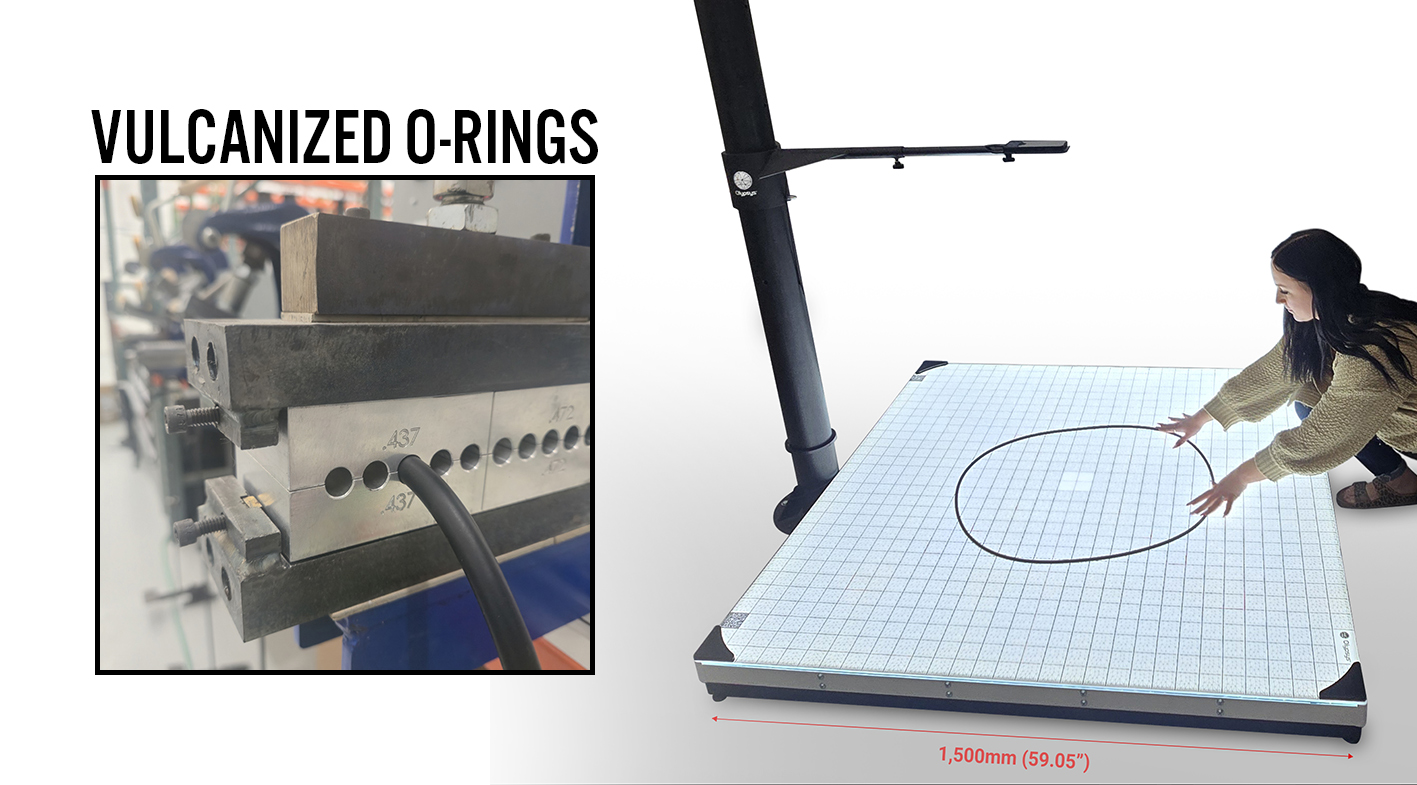
Most shops can splice cord. Far fewer can post tight large-ring tolerances and then prove every piece with optical measurement before it ships. That is the gap The O-Ring Store fills: we make precision vulcanized O-Rings in-house and document ID, OD, and cross-section on the same Olypsys® Large Format system we sell to the industry.
When the dash size is missing from the chart, or the diameter is too large to mold economically, a spliced and vulcanized O-Ring is the practical answer. Cut cord to length, fuse the ends under heat and pressure, inspect to a published class, and put a Measurement Verification CofC with the shipment when QA needs the paper trail.
Shop Vulcanized O-Rings Shop Olypsys® Measurement Cord Cut Length Calculator
Why The O-Ring Store does it best
Four things separate a vulcanized ring you can trust from a splice you hope fits:
- Posted tolerance classes. O-Rings are not shipped if tolerances are not met. Through 48" OD we hold Class 2 (±0.80% to ±1.00%) on ID. Above 48" we hold Class 3 (±1.20% to ±1.50%). Those numbers go on prints and receiving plans.
- Olypsys® Large Format inspection on rings under 48" OD. Contactless ID, OD, and CS on a calibrated Olypsys® Large Format Grid, with optional Measurement Verification CofC. Through 48" OD, Olypsys® Large Format is the dimensional system of record. The ring lies free on the grid, so the reading reflects the free size of the part and stays free of the stretch-to-fit and operator-feel errors common with contact tools. Documented dimensions give both us and our customers the traceability a typical vulcanizing department often lacks.
- We build the measurement stack and use it on our own production. Olypsys® grids and vision booths are products we sell (Olypsys® category). Using that same Large Format capability on vulcanized work means make and prove happen in one ISO 9001:2015 quality system. That combination is uncommon.
- In-house speed at useful volume. About 100 custom rings per day capacity, with typical lead time around 5 days for up to 50 pieces (longer for big lots or special compounds). No waiting on a one-off mold for a static cover seal.
When a vulcanized O-Ring is the right call
Standard molded AS568 and metric rings cover most jobs. They fall short when:
- The inside diameter is oversized or odd (common from about 5.5" ID upward, and well past 48" OD)
- You need a few pieces, not a molded production run with tooling cost and MOQ
- Downtime will not wait weeks for a special mold
- A legacy machine or custom housing was never designed around a catalog dash
Typical homes for these rings: large flanges and manways, filter housings, tank lids, valve rebuilds, OEM prototypes, food and beverage sanitary covers, and water-treatment equipment. For continuous molded large rings vs vulcanized Viton® tradeoffs, see Vulcanized Viton® FKM vs Continuously Molded.
Static service only. Vulcanized joints belong on face seals, covers, and housings that do not scrub the splice under motion. For dynamic rods, pistons, or high-cycle rotary duty, prefer a molded or continuously molded ring.
Vulcanized vs glued vs molded
| Method | How it is made | Strengths | Limits |
|---|---|---|---|
| Molded | One-piece cure in a mold | Uniform CS, best for dynamic / high pressure | Tooling, lead time, size limits |
| Vulcanized (spliced) | Cord cut to length, ends fused with uncured rubber under heat and pressure | Any ID from stock cord, fast, no mold, strong static joint | Joint is a designed feature; keep it static |
| Field glued | Cyanoacrylate or similar on cut ends | Fast emergency fix | Weaker, less elastic, poorer temperature and fluid resistance |
A true vulcanized splice uses compatible uncured compound and heat/pressure so the joint cross-links into the cord. That is a different product from a glue line on the truck. At The O-Ring Store the difference also includes dimensional proof after the cure, not only a strong joint.
How we make them (and why the process holds tolerance)
- Select cord. Match compound, durometer, and cross-section to the fluid and groove. Stock cord covers Buna-N, Viton® (FKM), EPDM, silicone, and other families. See O-Ring Cord Stock.
- Calculate cut length. Mean circumference: (ID + CS) × π. The Cord Cut Length Calculator does the math. Cutting to ID alone leaves the ring short by one cross-section of circumference.
- Precision cut and vulcanize. Ends are prepared, bonded with uncured rubber, and cured in a splice mold under heat and pressure.
- Finish and inspect to class. Flash is cleaned, the joint is checked, and dimensions are verified to the posted Class 2 or Class 3 for that size. Through 48" OD, dimensional proof is Olypsys® Large Format only.
In-house capacity is on the order of about 100 custom rings per day. Typical lead time is about 5 days for up to 50 pieces (longer for larger quantities or special compounds). That is how MRO and OEM jobs get a custom static seal without a tooling project.
Industry standard tolerances (what the standards actually cover)
AS568 and ISO 3601-1 set ID and cross-section tolerances for molded O-Rings on a dash or metric size list. They do not publish a finished-ID table for custom vulcanized rings cut from cord. For spliced / extruded rubber, the industry reference is the ARPM Rubber Handbook (still widely called RMA), with the same extrusion classes mirrored internationally in ISO 3302-1.
Three ARPM tables matter for vulcanized O-Ring work:
| What you are controlling | Industry standard | Typical class we work to |
|---|---|---|
| Cord cross-section (wall) | ARPM Table 13 / ISO 3302-1 (E1 / E2 / E3) | E2 Precision |
| Spliced cord length | ARPM Table 18 (S1 / S2 / S3) | S2 Precision |
| Large finished ID (percentage) | ARPM Table 20 large-ID percentages (EN1 / EN2 / EN3) | Aligns with our posted Class 2 / Class 3 |
ARPM Table 20 large-ID percentages (industry framework)
For large internal diameters, ARPM Table 20 (mandrel-supported / large extrusion ID practice) switches from fixed inch/mm bands to percent of ID:
| ARPM class | Drawing designation | Large-ID tolerance (over about 6.30" / 160 mm) |
|---|---|---|
| High Precision | EN1 | ±0.6% |
| Commercial / Precision band | EN2 | ±0.8% |
| Non-critical | EN3 | ±1.2% |
That percentage framework is why reputable vulcanizing shops publish Class 2 / Class 3 ID tolerances on large custom rings. AS568 dash tolerances stop being a practical finished callout once diameters reach the vulcanized size range.
ARPM Table 18 spliced-length tolerances (S2 Precision, inch)
Cord is cut to a calculated length before vulcanizing. ARPM Table 18 sets spliced-length classes in length bands that widen as the stick of cord gets longer. S2 Precision (common production callout):
| Spliced length (above to up to) | S2 Precision (± in) |
|---|---|
| 0 to 10" | ±0.25 |
| 10 to 16" | ±0.28 |
| 16 to 25" | ±0.32 |
| 25 to 40" | ±0.36 |
| 40 to 63" | ±0.40 |
| 63 to 100" | ±0.45 |
| over 100" | ±0.50 |
Cut length ≈ (ID + CS) × π, so a length error of ΔL shows up on the finished ring as about ΔL / π on ID. Shops that publish fixed ID bands (for example ±0.14" near a 30" ID) are often converting these length bands into diameter.
That length-band path is useful for cutting discipline. On its own it is still a contact-era, operator-dependent control story: tape measures, cut fixtures, and later pi-tape or caliper checks on the closed ring. Soft vulcanized cord compresses under a tape or jaws. A pi-tape pulled snug around the ID can stretch the ring enough to make a borderline part look like it matches the work order when the free size is still out. Human feel on how hard to pull the tape becomes part of the number. Finished-ring proof needs a measurement that leaves the O-Ring unloaded.
Posted dimensional tolerances (finished vulcanized O-Ring)
These are the finished-ring ID tolerances we publish and inspect to. They sit in the same percentage world as ARPM Table 20 for large IDs and are sized for custom vulcanized product. Publishing the class is part of doing the job right: you know what you ordered, and receiving knows what to check. O-Rings are not shipped if tolerances are not met.
| Finished size | Our posted class | Typical ID tolerance | Industry alignment | How we verify |
|---|---|---|---|---|
| Up to 48" (1219 mm) OD | Class 2 | ±0.80% to ±1.00% | At or near ARPM Table 20 EN2 (±0.8%), with a defined upper band | Olypsys® Large Format only |
| Above 48" OD | Class 3 | ±1.20% to ±1.50% | At or near ARPM Table 20 EN3 (±1.2%), with a defined upper band for very large rings | Visual + pi-tape |
Example: a 30" ID Class 2 ring at ±0.8% is held to roughly ±0.24" on ID. That is tight enough for the large static glands these rings serve, and it is a published number you can put on a print or receiving inspection plan.
Every vulcanized O-Ring in the Large Format inspection range can ship with a Measurement Verification Certificate of Conformance (CofC) that records the measured ID, OD, and cross-section against the order. Ask for it when aerospace, food, pharma, or OEM quality systems need evidence, not assurance language.
How the market usually posts vulcanized tolerances
Most vulcanizing suppliers either point at ARPM / RMA Table 18 (spliced length tolerance, sometimes converted to ID) or publish a short fixed-inch / percentage note. Few post a clear finished-ID Class 2 / Class 3 band and an optical Large Format inspection method with a Measurement Verification CofC.
| Approach | What is typically posted for vulcanized / spliced ID | Typical inspection story |
|---|---|---|
| The O-Ring Store | Class 2 ±0.80% to ±1.00% through 48" OD; Class 3 ±1.20% to ±1.50% above | Olypsys® Large Format only through 48" OD; optional Measurement Verification CofC |
| RMA Table 18 callout | ID “per S1” (premium) or “per S2” (standard), sometimes “per quote” | Length-class reference; Large Format optical proof usually not the production system of record |
| Fixed ID bands from S2 length | Inch bands converted from Table 18 (for example about ±0.14" near 20–32" ID; ±0.16" above ~32") | Conversion table on a flyer; no Olypsys® Large Format CofC path |
| Cord-first posting | Strong on cord E2 (ARPM Table 13); finished-ID class not the headline | Often 100% visual joint inspection |
| Flat percentage note | Large ID often about ±0.5% after a size breakpoint | Process handbook note; not an Olypsys® Large Format CofC story |
| Developed-length bands | Fixed inches on shorter splices, then about ±0.5% of developed length on longer ones | Catalog / engineering guidelines for spliced products |
How to read that table. A fixed ±0.14" or a ±0.5% callout can look tight on paper next to a ±0.8% Class 2 band on a 30" ID. The stronger package is a published ship-hold class, a contactless Large Format measurement of the finished ring, and a CofC with ID / OD / CS. Length-table conversions, pi-tape, and calipers stay tied to contact force and operator feel on soft, slightly out-of-round vulcanized rings. Through 48" OD, our dimensional system of record is Olypsys® Large Format.
Cord cross-section tolerance (ARPM Table 13 / ISO 3302-1)
The finished ring ID class sits on top of the extruded cord cross-section tolerance. Cord is governed by ARPM Table 13 (same numbers as ISO 3302-1 classes E1 / E2 / E3). Most commercial cord, including ours, ships to Class E2 (Precision).
On the common inch cross-sections that line up with AS568 series cord:
| Cord CS | E1 High Precision | E2 Precision (typical supply) | E3 Commercial |
|---|---|---|---|
| .070" | ± .008" | ± .014" | ± .020" |
| .103" / .139" | ± .010" | ± .016" | ± .027" |
| .210" | ± .014" | ± .020" | ± .031" |
| .275" | ± .016" | ± .027" | ± .039" |
Full tables, millimeter columns, and notes on soft / post-cured compounds: O-Ring Cord Tolerances.
When you design the groove, budget both: cord CS tolerance on the wall, and the vulcanized ID class on the diameter. We inspect both sides of that stack so large custom seals stay predictable on paper and on the receiving dock.
Olypsys® Large Format: contactless proof on large vulcanized O-Rings
Cutting cord is the easy step. On a dinner-plate to roughly 48" OD ring, the hard step is proving ID and cross-section after the splice is closed.
Contact tools stay error-prone on these parts. A pi-tape wraps the ID or OD and depends on how hard the operator pulls. Soft vulcanized cord will give under that tension. It is possible to stretch the ID while measuring until the tape reading matches the work-order size, even when the unloaded ring sits outside class. Calipers pinch the cord and move with jaw pressure and where you land on an out-of-round splice. Both methods are contact-based, operator-dependent, and easy to bias toward a number already written on the traveler.
Olypsys® Large Format is contactless. Through 48" OD, The O-Ring Store inspects vulcanized O-Rings on the Olypsys® Large Format booth / large-format grid. The ring lies free on a calibrated, backlit field. Optical capture and elastomer-aware measurement return ID, OD, and CS from the free outline of the part. There is no tape to snug, no jaw to squeeze, and no path to stretch the ring until it “fits” the work order. Slight ellipse in a large spliced ring is measured as it sits, which is how the seal actually behaves before it is installed.
That matters on unique vulcanized applications:
- Large static glands need tight percentage ID control so cover bolt patterns and groove squeeze stay in range
- Soft cord, vulcanized joints, and out-of-round large rings need a free-state reading
- Olypsys® produces a repeatable, documentable result for the CofC and for QA, aerospace, food, or pharma receiving
- Enterprise vision booths in the Olypsys® line cover up to about 1200 mm (47.2") OD, which aligns with the Class 2 Large Format inspection window
We sell that measurement stack and run it on our own vulcanized production. Make the ring and prove the ring in one shop is why customers who need evidence source large custom rings here.
More on the method: How to Measure an O-Ring and How Olypsys® works.
Materials we vulcanize
Same families you already specify for molded rings, supplied as cord and closed into a custom ID:
- Nitrile (Buna-N): oils, fuels, hydraulics; everyday industrial choice
- Viton® / FKM: heat and aggressive chemicals
- EPDM: water, steam, weather, many polar fluids (not petroleum oils)
- Silicone: wide temperature, many FDA grades for food and pharma covers
Pair the compound with the Chemical Compatibility Chart and Shore A Hardness guidance the same way you would for a molded ring. Hardness still sets extrusion margin and sealing feel; chemistry still sets whether the polymer survives the fluid. Application help is part of the order path: size, material, and whether you need Olypsys® verification on the pack list.
Quality system behind the splice
- ISO 9001:2015 certified quality management
- 100% dimensional inspection path for vulcanized rings in the Large Format range
- Olypsys® Large Format as the optical proof method under 48" OD
- Material certifications available when the job requires them
- Optional labeling, barcoding, and packaging for OEM and MRO inventory control
- Remake commitment when a part does not meet the posted class
For what a CofC can include on O-Ring shipments in general, see O-Ring Certificate of Conformance.
Practical selection checklist
- Confirm static duty. If the seal moves, ask about molded or continuously molded options first.
- Lock ID × CS (or OD × CS) from the groove or the failed sample. Measure with Olypsys® when you can.
- Pick the compound for fluid and temperature, then durometer for squeeze and gap.
- Call out the tolerance class on the PO or print (Class 2 through 48" OD; Class 3 above).
- Request the Olypsys® Measurement Verification / CofC when receiving inspection or regulated quality systems need the paper trail.
- Use the Cord Cut Length Calculator if you are splicing in the field; order vulcanized from The O-Ring Store when the joint has to last and the size has to be proven.
Quick answers
What is a vulcanized O-Ring?
A custom ring made from extruded cord with the ends fused under heat and pressure so the
joint cures into the rubber. It is not a cyanoacrylate field splice.
What tolerances apply?
Industry framework: ARPM Table 13 / ISO 3302-1 for cord CS (typically E2),
ARPM Table 18 for spliced length (typically S2), and ARPM Table 20 large-ID
percentages (±0.6% / ±0.8% / ±1.2% for EN1 / EN2 / EN3). AS568 / ISO 3601-1 cover
molded dashes, not custom vulcanized IDs. We post and inspect to Class 2:
±0.80% to ±1.00% through 48" OD (Olypsys® Large Format only) and Class 3:
±1.20% to ±1.50% above 48" OD (visual + pi-tape). Rings outside class are not shipped.
Market postings often stop at ARPM Table 18 length classes, fixed-inch conversions, or a
±0.5% note. Our Class 2 path pairs the posted band with contactless Large Format proof and
an optional Measurement Verification CofC.
Why does The O-Ring Store do vulcanized O-Rings best?
Posted Class 2 / Class 3 tolerances, in-house capacity and lead times measured in days,
and Olypsys® Large Format inspection that turns a large custom ring into a documented
ID/OD/CS result with optional CofC. We sell the measurement tools and use them on our own
production, so make and prove stay in one quality system.
Where do I order?
Vulcanized O-Rings (custom).
Vulcanized O-Rings are a production method for custom static sizes. Always match compound, hardness, and groove design to the real fluid, temperature, and pressure. Contact The O-Ring Store with ID, CS, material, quantity, and whether you need Olypsys® verification on the pack list.