
Low-Temperature Brittleness Testing: Impact Crack Points vs TR-10
What ASTM D2137 / ISO 812 low-temperature brittleness means for O-Rings: impact crack temperature, test sequence, how it differs from TR-10 cold sealing, family notes, and how seal engineers read the number.
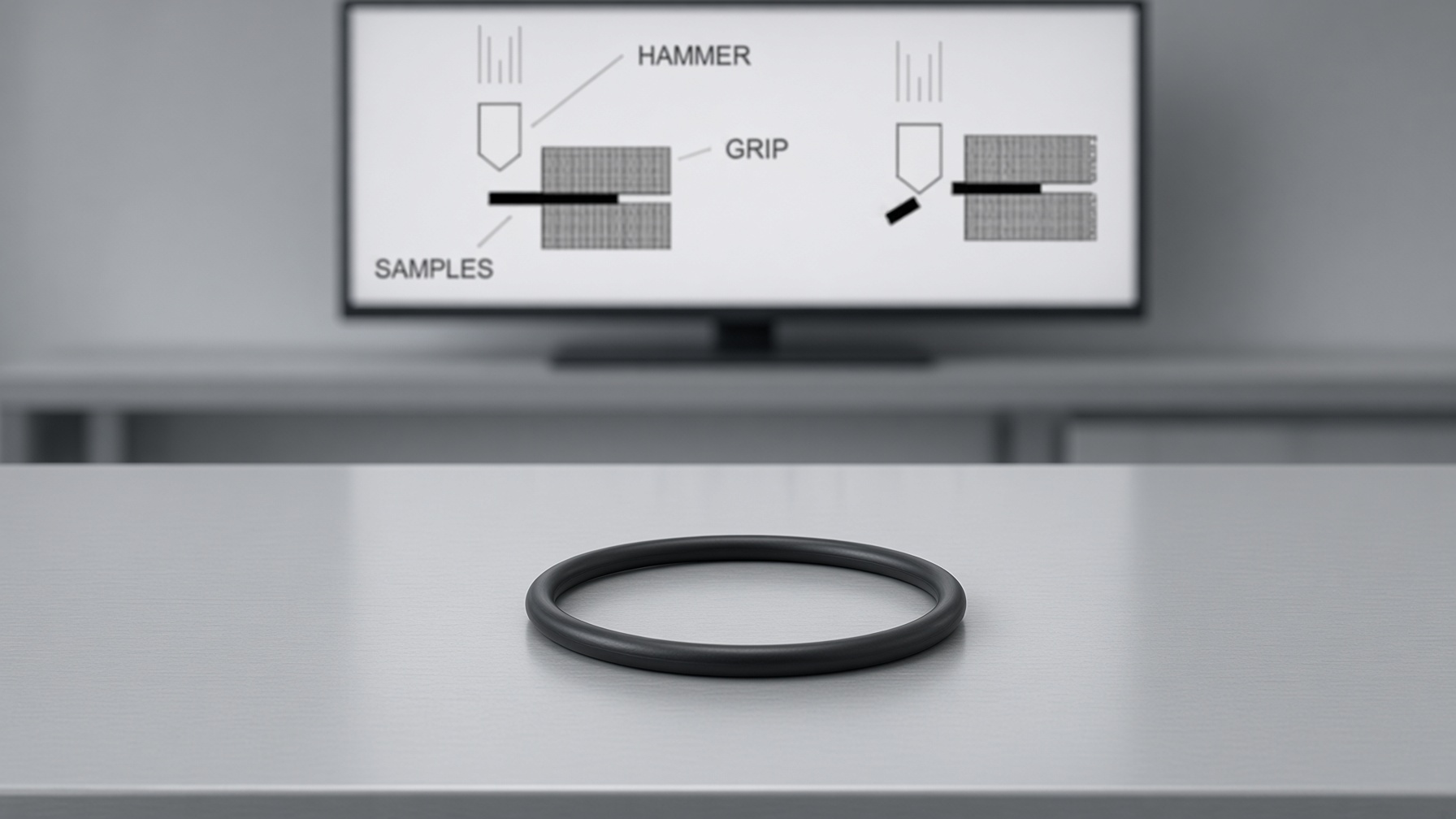
Low-temperature brittleness testing answers a sharp cold question: will the rubber crack or shatter when struck while frozen? ASTM D2137 and ISO 812 cool cantilever specimens, hit them at a controlled speed, and find the lowest temperature where fractures stop appearing.
That number is valuable for impact, handling, and high strain-rate abuse. It is not the same as cold squeeze sealing. For O-Ring recovery in a gland, TR-10 remains the primary cold guide.
This article expands the brittleness note in the O-Ring Temperature Guide into a full working explanation: what the impact test measures, how the sequence runs, how seal engineers use it beside TR-10, and how to read a datasheet line without mixing the two stories.
TR-10 Testing Temperature Guide Failure Modes Ask About a Compound
Why impact brittleness matters for seals
Rubber seals because polymer chains can move and push back. Cold slows that motion. Keep cooling and the compound stiffens. At a low enough temperature and a high enough strain rate, a sudden bend or impact can open a crack instead of a smooth flex.
Brittleness testing captures that shatter risk. It matters when:
- Parts see cold assembly, drop, or shock while frozen.
- Dynamic lips or covers can snap under a fast deflection.
- A specification calls for a pass/fail impact temperature (common in material callouts).
For quiet static lids that only need squeeze force after a cold soak, loss of recovery usually shows up before impact cracking. That is why seal houses lean on TR-10 for cold gland design and keep brittleness as the abuse / specification companion. See the cold service section in the Temperature Guide.
What low-temperature brittleness is
Low-temperature brittleness (also called the brittle point or brittleness temperature) is the lowest temperature at which vulcanized rubber specimens do not fracture or crack when struck under the impact conditions in ASTM D2137 (and the closely related ISO 812).
In plain language: cool the strip, hit it, and ask whether it still bends or whether it breaks. The reported temperature is the coldest point where the set of specimens survives that blow without visible cracks.
Labs and standards describe related procedures:
| Result style | What it answers |
|---|---|
| Brittleness temperature (lowest non-failure) | Coldest temperature where specimens pass the impact without cracks (ASTM D2137 Method A style; ISO 812 Procedure A) |
| 50% brittleness temperature | Temperature where half the specimens fail (ISO 812 Procedure B) |
| Pass / fail at a stated °C | Specimens impacted at one specification temperature (ISO 812 Procedure C; common datasheet line) |
The standards themselves caution that the measured temperature does not automatically equal the lowest service temperature. Impact rate, specimen geometry, and the kind of deformation in the product all matter. Use the number for duties that look like the test: sudden cold flex under comparable speed and strain.
Brittleness in one picture
Cantilever specimens sit cold in a clamp. A striker delivers a controlled impact. Pass means no crack; fail means fracture or a visible fissure after the bend check.
How the brittleness test works
ASTM D2137 covers rubber vulcanizates and rubber-coated fabrics under specified impact conditions. Seal-compound work most often follows the vulcanizate path (Method A style). ISO 812 is the common international counterpart with Procedures A, B, and C. Always read the procedure, medium (liquid or gas), and reported temperature style on the report.
Brittleness test sequence
Typical lowest-non-failure workflow. Exact fixture clearances, soak times, and specimen geometry belong on the datasheet line.
- 1 Cut & mount Die-cut strips (vulcanizate Type B style is commonly about 25 mm long × 6.4 mm wide × 2 mm thick). Clamp several specimens as cantilevers. Five specimens per temperature is typical practice.
- 2 Cool Bring the bath or chamber below the expected non-failure temperature. Soak: about 5 minutes in a liquid medium or about 10 minutes in a gaseous medium.
- 3 Impact Deliver a single strike. ASTM D2137 targets about 2.0 ± 0.2 m/s with a striker edge radius of about 1.6 mm. Calibrated speed matters; a soft hit changes the result.
- 4 Inspect Failure is any crack, fissure, hole, or complete break visible to the naked eye. Specimens that stay in one piece are bent about 90° in the impact direction to reveal hidden cracks.
- 5 Find the floor Step warmer (often 10°C, then refine near 2°C) with new specimens each time until the lowest temperature of non-failure is known. That temperature is the brittleness temperature.
Specimen notes (typical practice)
- Vulcanizate strips from a cured slab are the usual laboratory path for compound ranking.
- Thickness near 2.0 mm keeps results comparable; coated-fabric methods use different geometries and bend checks.
- Use fresh specimens at each temperature. A prior impact changes the story.
- Liquid baths and gas chambers both appear in the standards. Soak time and heat-transfer medium belong beside the reported °C.
- Specification work often uses a single temperature pass/fail (ISO 812 Procedure C) instead of hunting the exact brittle floor. Read which style the datasheet used.
How seal engineers use brittleness in practice
Duty reading of brittleness
Impact survival is the abuse screen. Squeeze recovery after a cold soak is still a TR-10 story.
Brittleness is the working screen
Cold assembly snaps, frozen shipping shocks, and fast deflections need a compound that survives impact at the coldest expected temperature. Treat the brittle point (or the pass temperature) as the shatter floor for that kind of duty.
Lead with TR-10
Quiet lids and pressurized glands care first about elastic push-back after a cold soak. A compound can pass a cold impact and still sit too stiff to seal. Pair brittleness with TR-10 before you call the cold design done.
Catalog check: A line that says “brittleness −40°C” and a line that says “passes ASTM D2137 at −40°C” are related but not identical claims. One hunts the floor. The other proves survival at one temperature. Ask which procedure and medium were used.
Design takeaways
- Use brittleness for shatter and specification risk. Use TR-10 for cold recovery in the gland.
- Harder durometers and high strain rates move you toward cracking sooner than a soft static soak suggests.
- Plasticizer-rich recipes can look flexible on the bench and still embrittle after cold dwell or fluid extraction.
- Field cracks after a cold shock belong in the same conversation as heat hardening and cracking in failure modes, with temperature and impact as the cold-side drivers.
Brittleness compared with TR-10
This is the comparison seal engineers need for cold service. Both tests live on the cold end of the datasheet. They answer different questions.
Impact crack point vs cold retraction
Brittleness asks whether the rubber breaks when struck cold. TR-10 asks when stretched rubber starts recovering on warm-up.
ASTM D2137 / ISO 812
High strain-rate impact on cold cantilevers. Result: lowest non-failure temperature, 50% failure temperature, or pass/fail at a stated °C.
ASTM D1329 / ISO 2921
Stretch, freeze, release, warm. Result: temperature for 10% retraction (and often TR70). Closest everyday guide for O-Ring cold recovery.
Use both, weight TR-10
For gland sealing after a cold soak, treat TR-10 as the working floor (with the usual static margin rules). Keep brittleness as the crack / specification companion.
| Question | Prefer |
|---|---|
| Will the ring still push back in the groove when cold? | TR-10 |
| Will the rubber crack if bent or struck hard while frozen? | Brittleness (D2137 / ISO 812) |
| Does a published “min temp” already include a static margin? | Ask; many catalogs start from TR-10, not brittle point |
| Spec requires a cold impact pass? | Report the exact procedure and temperature |
Among polymers of similar type, TR-10 often ranks with brittle-point ordering. Absolute temperatures still diverge. Brittleness is typically colder than TR-10 on the same grade, which is exactly why a “passes −40°C impact” claim can sit beside a warmer TR-10 and still leave a sealing gap at −35°C. Design the gland to the recovery number, then confirm impact survival if the duty includes shock.
Typical brittleness notes by elastomer family
Datasheets often post a pass temperature rather than a continuous brittle-point hunt. The chart below shows approximate commercial midpoints for illustrative ranking on a fixed scale from −80°C to 0°C. Longer bars mean colder (better) impact survival. Real grades scatter. Always use the grade datasheet.
Typical brittleness temperature by elastomer family
Approximate midpoints. Bar length = coldness on a −80°C → 0°C scale. Color: blue (colder) → teal → green → amber → red (warmer). Many sheets report pass/fail at one °C instead of this floor.
Width % = |brittleness| ÷ 80 on a −80°C to 0°C scale. Color runs cold (blue) → warm (red). Use grade datasheet values; compare with TR-10 on the same grade before cold seal design.
| Family | Typical brittleness midpoint | Cold-service notes |
|---|---|---|
| Silicone (VMQ) | −70°C (−94°F) | Excellent impact survival in deep cold; still confirm tear and abrasion for dynamic glands |
| Fluorosilicone (FVMQ) | −65°C (−85°F) | Cold flex with better fuel resistance than silicone; keep strength limits in view |
| EPDM | −55°C (−67°F) | Strong cold performer for water, steam, and many polar fluids |
| NBR (low-temp grades) | −45°C (−49°F) | Lower ACN recipes reach colder brittle points; oil swell tradeoffs remain |
| FKM (GLT-type) | −40°C (−40°F) | Low-temp fluorocarbon option when oil/fuel resistance must stay |
| Neoprene (CR) | −40°C (−40°F) | Outdoor / refrigerant heritage; confirm grade and crystallization behavior |
| HNBR | −35°C (−31°F) | Grade-dependent; tougher and hotter than NBR with a colder window on specialty stocks |
| NBR (general) | −30°C (−22°F) | Everyday oil service; cold impact and TR-10 both constrain the design |
| FKM (standard) | −25°C (−13°F) | Hot oil strength first; specify a low-temp grade when cold impact matters |
| FFKM | −15°C (5°F) | Extreme chemistry first; cold grades vary widely |
| Aflas® (FEPM) | −10°C (14°F) | Steam / amine strengths; not a deep-cold specialist |
Shop starting points when cold impact and fluid both matter: Silicone, EPDM, HNBR, and Viton® / FKM (ask for a low-temp FKM grade when the duty needs it).
Brittleness compared with related cold tests
| Test | What it measures | When seal engineers reach for it |
|---|---|---|
| Brittleness (ASTM D2137 / ISO 812) | Impact fracture while cold | Abuse, shock, and specification pass/fail |
| TR-10 (ASTM D1329 / ISO 2921) | Temperature for 10% retraction on warm-up | Primary cold guide for O-Ring squeeze sealing |
| Glass transition Tg (e.g. DSC) | Polymer transition toward glassy behavior | Materials baseline; less direct than TR-10 for glands |
| Low-temp stiffening (ASTM D1053 / ISO 1432) | Modulus rise (relative modulus) as temperature falls | Flexibility / twist stiffness maps |
| Low-temp compression set (ASTM D1229 / ISO 815-2) | Recovery after cold compression | Static lids that stay squeezed while cold |
For O-Rings, keep the hierarchy clear: TR-10 for sealing force, brittleness for crack risk, and the other cold tests when the duty needs stiffness or cold-set detail.
Reading a datasheet without getting fooled
- Find brittleness, brittle point, or ASTM D2137 / ISO 812, then read whether the value is a lowest non-failure temperature or a pass at X°C.
- Note the procedure, heat-transfer medium, and specimen type when listed.
- Pull TR-10 on the same grade. Do not treat a cold impact pass as a sealing floor.
- Match compound grade, not only polymer family. Low-temp NBR and GLT-type FKM exist for a reason.
- Confirm fluid and heat alongside cold. A great brittle point in the wrong oil is still a failed seal. Use the Chemical Compatibility Chart and the Temperature Guide with the impact story.
Practical selection checklist
- Write down the coldest soak, whether the seal is static or dynamic, and whether impact or fast flex is realistic.
- Shortlist families that survive the fluid and heat.
- Compare TR-10 (and TR70 when available) for sealing recovery.
- Add brittleness (floor or pass temperature) when shock, assembly abuse, or a specification requires it.
- Validate critical applications with the real compound in the real gland. Datasheet impact numbers rank crack risk; they do not replace application testing.
Quick answers
What does low-temperature brittleness mean?
It is the lowest temperature at which rubber specimens do not crack or fracture under the
controlled impact conditions of ASTM D2137 / ISO 812. Some datasheets instead report a
pass/fail result at one stated temperature.
Is the brittle point the same as the lowest sealing temperature?
No. Brittleness tracks impact crack risk. Cold squeeze sealing tracks recovery,
where TR-10 is the better everyday guide.
Dynamic or pressurized duty still treats TR-10 as the practical sealing floor.
Why can a compound pass −40°C impact and still leak at −30°C?
Impact survival and elastic push-back are different mechanisms. The ring can avoid cracking
and still sit too stiff to maintain contact stress after a cold soak. Read TR-10 on that
same grade.
Should I specify D2137 or ISO 812?
They are closely related impact-brittleness methods. Match the standard your customer or
material callout already uses, and record procedure, medium, and temperature style so
comparisons stay honest.
Where should I go next?
Start with the Temperature Guide and the
deep TR-10 article, then the material pages
for
Nitrile,
EPDM,
FKM / Viton®,
Silicone, and
Fluorosilicone.
Contact The O-Ring Store with fluid, pressure, static vs dynamic
duty, coldest temperature, and whether impact or shock is in the duty cycle.
Brittleness temperatures and pass/fail ratings vary by compound, specimen, and test condition. Use grade-specific data for design decisions, and validate critical seals under the real fluid, pressure, cold soak, and impact profile.
