
Compression Set Elastomer Testing: Why Flattened O-Rings Stop Sealing
What compression set means for O-Rings: ASTM D395 / ISO 815 test methods, how to read % set, Method B vs button tests, and how seal engineers use the number for long-term squeeze.
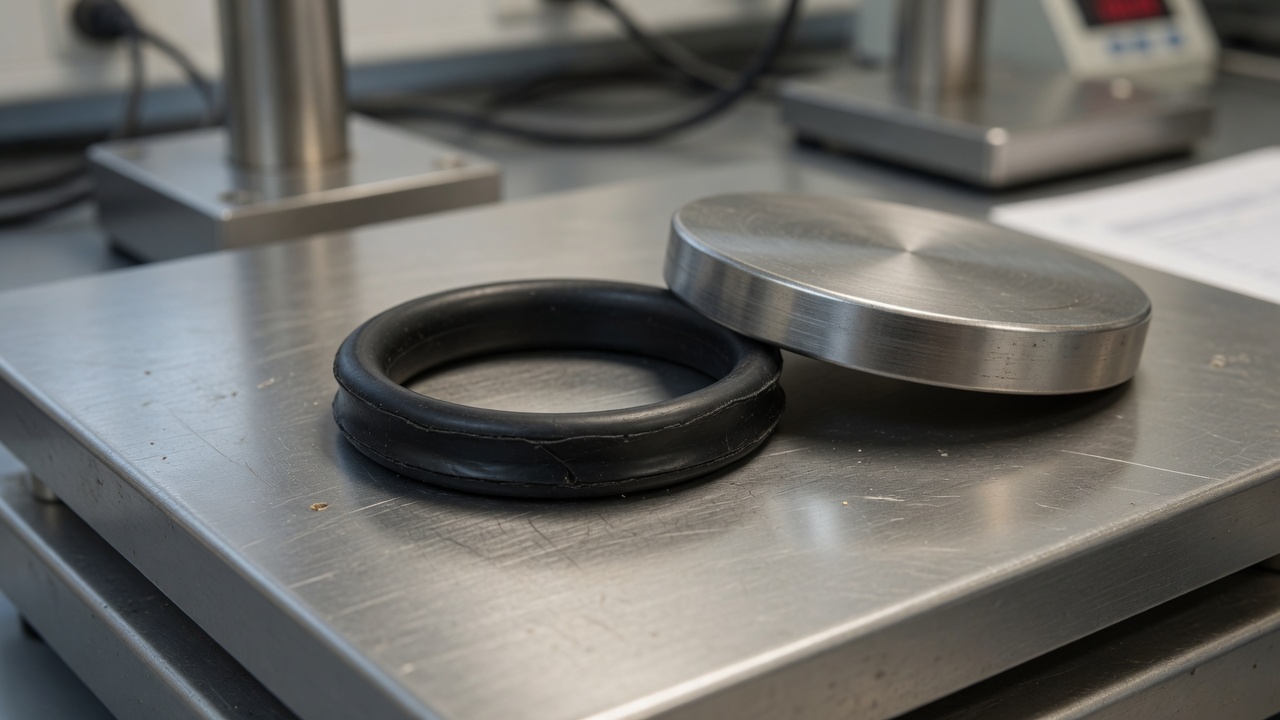
Compression set is the heat-and-time number that predicts whether an O-Ring will still push back after a long dwell under squeeze. The test compresses rubber, holds it, then asks how much of the original thickness never comes back.
A low compression set keeps sealing force alive in static lids, flanges, and covers. A high set leaves a permanent flat. The gland still looks closed. The leak path opens when pressure or thermal cycling arrives.
This article pairs with TR-10 elastomer testing (cold recovery) and the compression-set failure mode overview. Here the focus is the lab method, how to read the percentage, and how seal engineers use it.
TR-10 Testing Failure Modes Material Pages Ask About a Compound
Why permanent set matters for seals
An O-Ring seals because elastic recovery presses the rubber into the gland surfaces. Compression set measures how much of that recovery is lost after a fixed compressive strain, time, and temperature.
When set climbs:
- Contact stress falls even if the groove dimensions are unchanged.
- Thermal cycles and pressure pulses find a leak path sooner.
- A ring that looked fine at assembly shows a shiny flat after teardown.
Compression set is a high-temperature / long-dwell story more often than a cold story. Pair it with TR-10 when the duty sees both heat soak and cold start.
What compression set is
Compression set is the percentage of original deflection that remains after the specimen is released and allowed to recover. In plain language: of the thickness you squeezed out, how much never returned?
Labs commonly follow ASTM D395 (and the closely related ISO 815 family). Results are reported as a percentage. Lower is better for sealing force retention.
Two ideas get confused on datasheets:
| Term | What it answers |
|---|---|
| Compression set | How much permanent thickness loss remains after a fixed squeeze, time, and temperature |
| Compression stress relaxation | How much force decays while the rubber stays at constant compression |
Set is geometry after release. Stress relaxation is force while still squeezed. Both matter; most O-Ring catalogs lead with compression set because it is widely posted and easy to compare.
Compression set in one picture
Original thickness t0, compressed thickness tc, recovered thickness tr. Set uses the unrecovered share of the imposed deflection.
How the compression set test works
ASTM D395 offers more than one apparatus path. O-Ring and seal compound datasheets most often cite Method B (compression device / spaced plates) on buttons or sliced specimens. ISO 815 is the common international counterpart. Always read the method, temperature, time, and strain on the report.
Compression set test sequence
Typical Method B workflow. Exact fixture, strain, time, and temperature belong on the datasheet line.
- 1 Measure t₀ Record original specimen thickness carefully. Small micrometer error becomes a large % set error.
- 2 Compress Clamp to a fixed strain (often about 25%) using spacers so every specimen sees the same deflection.
- 3 Age Hold time and temperature (for example 22 h or 70 h at a stated °C). Heat accelerates set for most compounds.
- 4 Release & cool Open the fixture, allow a short standard recovery window at room temperature, then measure recovered thickness tr.
- 5 Calculate % set % set = (t₀ − tr) / (t₀ − tc) × 100. Report method, hours, and temperature beside the number.
Specimen notes (typical practice)
- Cured buttons from a slab are the usual lab path; some houses also test cut O-Ring sections when geometry allows a valid reading.
- Surface grind or mold finish must be even. Tapered buttons skew thickness.
- Run multiple specimens and average. One outlier can move a borderline compound across a customer limit.
- Fluid-aged compression set (immersion, then set) is a different, tougher ask than dry heat set. Ask for it when the seal lives in oil, fuel, or process chemistry.
How seal engineers use compression set in practice
Duty reading of compression set
Static heat-soak glands care most. Dynamic glands still care, and they add wear and extrusion to the story.
Low % set is the working target
Flanges, covers, and lids that sit compressed for months at temperature need compounds that keep pushing back. Treat datasheet set at or above your soak temperature as the first screen.
Set plus modulus and wear
Rods and shafts still lose squeeze from set, and they also see friction heat, abrasion, and extrusion. A great set number with the wrong hardness or fluid swell is still a short seal life.
Catalog check: Compare set numbers only when method, strain, hours, and temperature match. A “15% set” at 70 °C for 22 h is not the same claim as 15% at 150 °C for 70 h.
Design takeaways
- Match the test temperature to the gland soak, with margin for hot spots.
- Higher squeeze can improve initial seal and can raise long-term set risk. Balance both.
- Fluid swell softens many compounds and can worsen effective sealing force even when dry-heat set looks fine.
- After teardown, a permanent flat is field evidence of high set or over-temperature service. See failure modes.
Typical compression set by elastomer family
The chart below shows approximate commercial midpoints for a common dry-heat Method B style screen (illustrative ranking, not a single ASTM condition). Shorter bars mean lower (better) % set. Real grades scatter widely with temperature and cure system. Always use the grade datasheet.
Typical compression set by elastomer family
Approximate midpoints on a 0–50% set scale. Color: green (lower set) → amber → red (higher set). Rankings shift with test temperature.
Width % = typical set ÷ 50 on a 0–50% scale. Use grade datasheet values at your temperature and hours for design.
| Family | Typical set midpoint (illustrative) | Sealing notes |
|---|---|---|
| FFKM | ~10% | Premium heat and chemical set resistance; confirm grade and cost |
| FKM | ~15% | Strong hot-oil set performance; pair with fluid compatibility |
| Aflas® (FEPM) | ~18% | Steam / amine service strength; check the exact aging condition |
| HNBR | ~20% | Tougher than NBR with better heat set in many grades |
| EPDM | ~22% | Solid water / steam / brake-fluid set behavior in the right grades |
| Silicone (VMQ) | ~25% | Wide grade scatter; high-temp set can rise fast on soft general-purpose stocks |
| NBR | ~30% | Everyday oil service; heat soak is often the set limit |
| Neoprene (CR) | ~35% | Outdoor / refrigerant heritage; confirm heat-set needs |
Shop starting points when heat set and fluid both matter: Viton® / FKM, HNBR, EPDM, and Silicone.
Compression set compared with related tests
| Test | What it measures | When seal engineers reach for it |
|---|---|---|
| Compression set (ASTM D395 / ISO 815) | Permanent thickness loss after fixed squeeze, time, and temperature | Primary long-dwell sealing-force screen |
| Compression stress relaxation | Force decay under constant compression | Critical bolted joints and quantified residual load |
| Heat aging (ASTM D573 / ISO 188) | Hardness / tensile / elongation shift after oven aging | Broader heat damage beyond set alone |
| TR-10 (ASTM D1329) | Cold retraction temperature | Cold start and low-temperature floors |
| Volume swell (ASTM D471) | Fluid-driven size and property change | Oil, fuel, and chemical service with set |
Reading a datasheet without getting fooled
- Find % compression set, then read method (often D395 Method B), hours, temperature, and strain.
- Confirm whether the specimen was dry-heat or fluid-aged.
- Compare only like-with-like across candidate grades.
- Check hardness and modulus beside set. Soft compounds can seal initially and still lose force quickly.
- Ask for stress-relaxation data when residual load is the real acceptance criteria.
Practical selection checklist
- Write down max soak temperature, dwell time, and static vs dynamic duty.
- Shortlist compounds that pass fluid compatibility at that temperature.
- Compare compression set on matching method / hours / °C.
- For cold starts, add TR-10.
- Validate critical glands with the real compound, squeeze, and fluid. Datasheet set is a screen, not a full life proof.
Quick answers
What does compression set mean?
It is the percentage of imposed compressive deflection that does not recover after a
stated time and temperature. Lower % set means more elastic push-back left for the seal.
Is 20% set good?
It depends entirely on the test condition and the duty. Twenty percent after 22 h at
70 °C can be routine for some nitrile grades. Twenty percent after 70 h at 200 °C on an
FKM screen would be a different conversation.
Why did my O-Ring come out flat?
Long dwell under squeeze at elevated temperature, over-compression, or a compound past its
heat capability are the usual causes. See
compression set in failure modes.
Does a low set grade fix a bad gland?
It helps retention of sealing force. It does not fix wrong stretch, sharp edges, chemical
attack, or insufficient squeeze.
Compression set values vary by compound, cure, and test condition. Use grade-specific data for design decisions.