Benzene O-Ring Compatibility: Which Compounds Hold Up
Benzene O-Ring guide for petrochemical and solvent service: chart ratings, why FKM is the preferred start, and which elastomers to avoid in aromatic hydrocarbon duty.
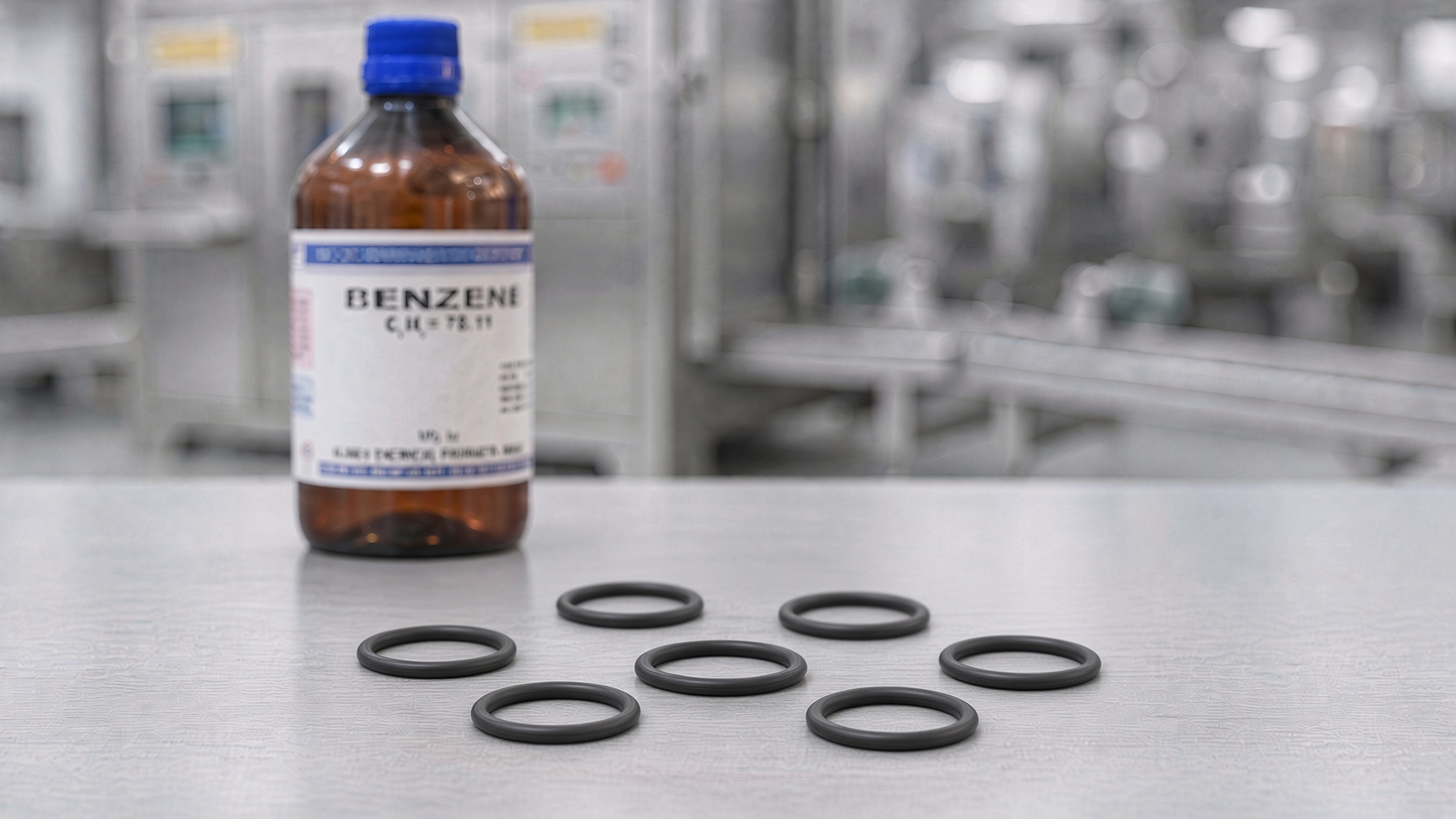
Benzene is a clear, volatile aromatic hydrocarbon used as a feedstock and solvent in petrochemical, chemical manufacturing, and laboratory process service. Seals on transfer valves, pump flanges, sample ports, reactor nozzles, and solvent totes see a strong aromatic that attacks many everyday elastomers. Pick poorly and you get heavy swell, softening, and early weep.
This guide maps the handbook Chemical Compatibility Chart row for benzene to practical compound choices. It is a deliberate break from mineral and synthetic lubricating-oil rows: aromatics punish oil-service stocks that look fine in crude-derived lubes.
Where it shows up
- Petrochemical and refining loops: benzene production, recovery, and transfer
- Chemical manufacturing: feedstock for styrene, cumene, cyclohexane, and related intermediates
- Solvent and extraction duty: process solvents and wash streams where benzene is still specified
- Sample and lab process connections: valves and fittings on analytical or pilot lines
- Drum, tote, and rail-car transfer: fill heads and pump skids moving neat or blended aromatics
Service is usually neat or solvent-cut aromatic hydrocarbon in steel or stainless equipment near ambient to moderately warm. Chart ratings assume a generic commercial compound near room temperature. Concentration, heat, and co-solvents change outcomes.
How benzene stresses an O-Ring
Aromatic hydrocarbons are aggressive toward many elastomer networks. They dissolve into nitrile, EPDM, neoprene, silicone, and butyl stocks and drive swell, modulus loss, and extrusion risk. Fluorocarbons (FKM and FFKM) and PTFE are the chart’s strong answers for this row. Heat and continuous immersion accelerate damage even when a short splash test looked acceptable. See Chemical Compatibility and Failure Analysis.
Handbook chart ratings for benzene
Same rating badges and layout as the interactive chart. Search benzene on the Chemical Compatibility Chart to pin the live row.
| Fluid | Best | N Nitrile | H HNBR | E EPDM | C Neoprene | S Silicone | V Viton® | P Urethane | F FVMQ | A Aflas® | B Butyl | K FFKM | T PTFE |
|---|---|---|---|---|---|---|---|---|---|---|---|---|---|
| Benzene | V | 4 | 4 | 4 | 4 | 4 | 1 | 4 | 3 | 2 | 4 | 1 | 1 |
Best family on the chart row: Viton® / FKM (V). FFKM and PTFE also rate excellent (1). Aflas® rates good (2). Fluorosilicone rates poor (3). Nitrile, HNBR, EPDM, neoprene, silicone, polyurethane, and butyl are not recommended (4).
Recommended O-Ring materials
First choice: Viton® / FKM
FKM (Viton®) is rated excellent (1) and is the chart’s preferred letter for benzene. It is the everyday fluorocarbon start for aromatic hydrocarbon transfer and static cover seals when temperature and pressure stay inside commercial FKM windows. Use 70 Shore A for most static flanges; step hardness or add a back-up ring when pressure and clearance gap climb.
Also usually serviceable
Materials to use with caution or avoid
Physical properties to match (after chemistry)
A chart 1 means the polymer family usually survives the fluid. Finish the spec with the gland and process needs:
- Hardness: 70 Shore A for most static covers and flanges; 90 Shore A or a back-up ring when pressure and gap climb (Shore A Hardness).
- Temperature: handbook chemical ratings are near room temperature. Warm benzene vapor and heat-traced lines age seals faster. Confirm continuous temperature against the Temperature Guide.
- Static vs dynamic: face and cover seals are mostly static; shafts and rods need abrasion and extrusion control beyond a chemical letter (groove design).
- Size: lock ID × CS (or the AS568 dash) on the Master O-Ring Size Chart before arguing compound.
Practical selection checklist
- Confirm neat benzene vs blend and any co-solvents on the SDS.
- Note temperature and whether the seal sees liquid, vapor, or both.
- Start with FKM at 70 Shore A for general static duty unless a plant standard already calls for FFKM or PTFE-encapsulated.
- Avoid nitrile, HNBR, EPDM, neoprene, silicone, polyurethane, and butyl for continuous benzene contact on this chart row.
- Pin Benzene on the Chemical Compatibility Chart. For critical service, contact The O-Ring Store with fluid grade, temperature, hardness, and duty cycle.
Quick answers
Which O-Ring for benzene?
Start with FKM (Viton®) at 70 Shore A for general static duty. FFKM and PTFE also
rate excellent. Aflas® is usually good for static service. Avoid nitrile and the other
4-rated families above for continuous aromatic contact.
Is benzene the same as gasoline or toluene on the chart?
Related aromatics and fuels show up in the same plants. Always match the exact fluid
name on the chart and on the SDS.
Chart ratings are guidance for generic commercial compounds near room temperature. Concentration, temperature, and co-fluids change outcomes. Evaluate specific parts before use in critical applications.