
Ammonia (Anhydrous) O-Ring Compatibility: Which Compounds Hold Up
Anhydrous ammonia O-Ring guide for refrigeration and process service: chart ratings, why neoprene and EPDM lead, and why FKM is the wrong start for NH3 duty.
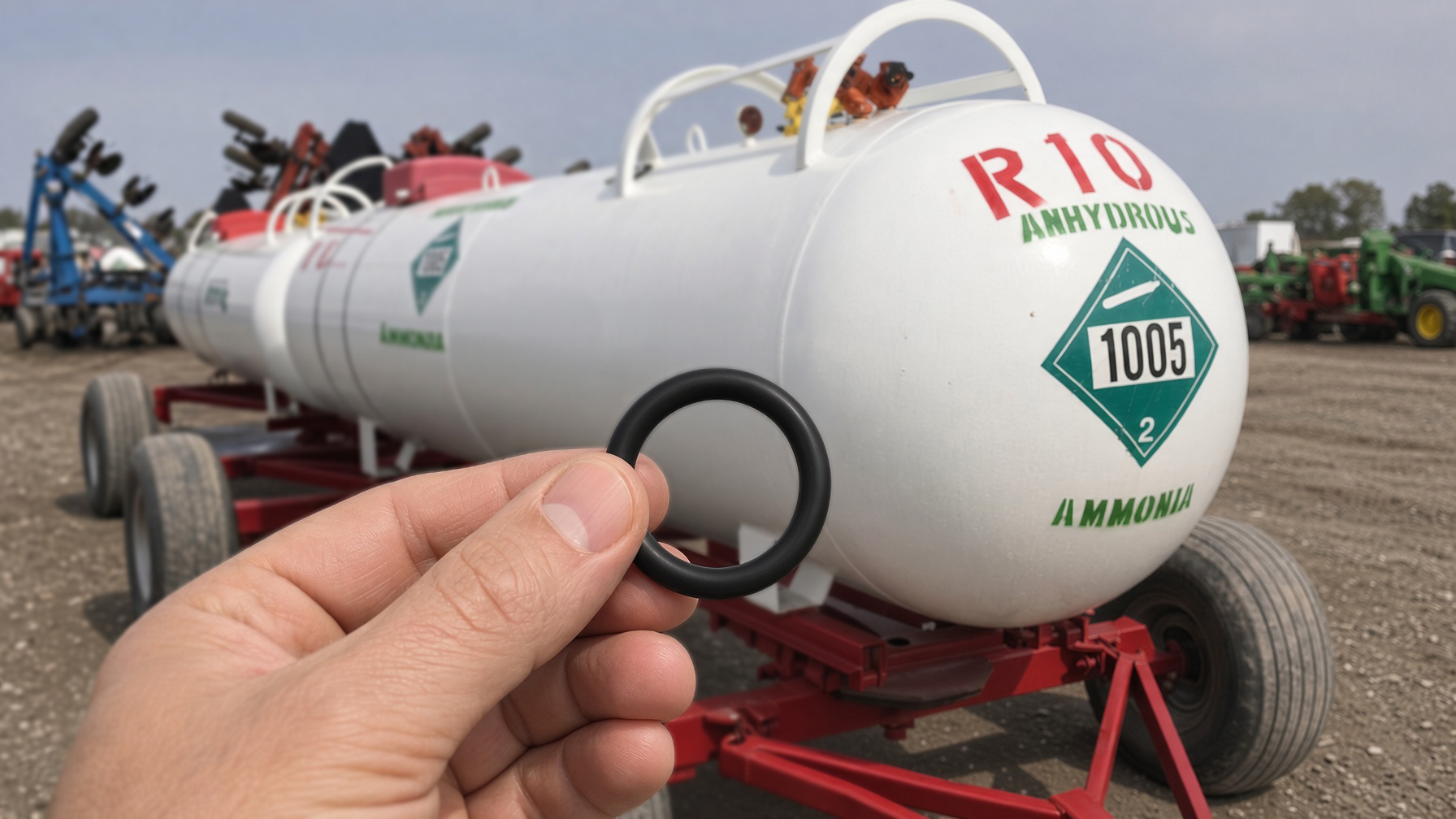
Anhydrous ammonia (NH₃) is a common refrigerant and process chemical in cold storage, fertilizer, and industrial gas service. Seals on compressor flanges, suction and discharge valves, liquid lines, and transfer fittings see a polar alkaline gas or liquid that treats everyday fluorocarbon stocks poorly. Pick FKM because it “handles chemicals” and you can get swell, blistering, and early leak paths.
This guide maps the handbook Chemical Compatibility Chart row for Ammonia (Anhydrous) to practical compound choices. Related rows for cold ammonia gas, hot ammonia gas, and liquid anhydrous ammonia sit nearby on the chart when your SDS wording differs.
Where it shows up
- Industrial refrigeration: ammonia compressors, evaporators, condensers, and valve stations in cold storage and process chilling
- Fertilizer and chemical plants: anhydrous ammonia storage, transfer, and injection
- Gas and liquid handling: cylinders, totes, rail-car unload, and pump skids
- Sample and instrument taps: pressure gauges and analyzer connections on NH₃ lines
- Maintenance and retrofit: cover seals and flange gaskets on legacy ammonia systems
Service may be gas, liquid, or both, often with oil carryover on the compressor side. Chart ratings assume a generic commercial compound near room temperature. Heat, oil mixtures, and concentration change outcomes.
How anhydrous ammonia stresses an O-Ring
Anhydrous ammonia is a polar, alkaline fluid. Many hydrocarbon-resistant fluorocarbons that shine in oil and aromatic duty struggle here. On this chart row, FKM, fluorosilicone, and polyurethane rate not recommended (4). Neoprene, EPDM, butyl, and PTFE rate excellent (1). Nitrile, HNBR, silicone, Aflas®, and FFKM land in the good (2) band for many static uses when the grade and temperature fit. Heat and continuous immersion still matter. See Chemical Compatibility and Failure Analysis.
Handbook chart ratings for ammonia (anhydrous)
Same rating badges and layout as the interactive chart. Search Ammonia (Anhydrous) on the Chemical Compatibility Chart to pin the live row.
| Fluid | Best | N Nitrile | H HNBR | E EPDM | C Neoprene | S Silicone | V Viton® | P Urethane | F FVMQ | A Aflas® | B Butyl | K FFKM | T PTFE |
|---|---|---|---|---|---|---|---|---|---|---|---|---|---|
| Ammonia (Anhydrous) | C | 2 | 2 | 1 | 1 | 2 | 4 | 4 | 4 | 2 | 1 | 2 | 1 |
Best family on the chart row: Neoprene (C). EPDM, butyl, and PTFE also rate excellent (1). Nitrile, HNBR, silicone, Aflas®, and FFKM rate good (2). Viton® / FKM, polyurethane, and fluorosilicone are not recommended (4).
Recommended O-Ring materials
First choice: Neoprene (CR)
Neoprene (CR) is rated excellent (1) and is the chart’s preferred letter for anhydrous ammonia. It is a strong everyday start for many ammonia refrigeration and transfer seals when temperature and oil exposure stay inside commercial CR windows. Use 70 Shore A for most static flanges; step hardness or add a back-up ring when pressure and clearance gap climb.
Also usually excellent on this row
Often workable (good)
Materials to avoid on this chart row
Physical properties to match (after chemistry)
A chart 1 means the polymer family usually survives the fluid. Finish the spec with the gland and process needs:
- Hardness: 70 Shore A for most static covers and flanges; 90 Shore A or a back-up ring when pressure and gap climb (Shore A Hardness).
- Temperature: handbook chemical ratings are near room temperature. Hot ammonia gas is a different chart row and a tougher ask. Confirm continuous temperature against the Temperature Guide.
- Oil carryover: compressor seals may see NH₃ plus refrigeration oil. Compatibility must cover both.
- Static vs dynamic: face and cover seals are mostly static; shafts and rods need abrasion and extrusion control beyond a chemical letter (groove design).
- Size: lock ID × CS (or the AS568 dash) on the Master O-Ring Size Chart before arguing compound.
Practical selection checklist
- Confirm anhydrous vs aqueous ammonia, and whether the seal sees gas, liquid, or both, from the SDS.
- Note temperature. Hot ammonia gas is a separate chart row from anhydrous / cold gas.
- Start with neoprene or EPDM at 70 Shore A for general static duty unless a plant standard already names another 1-rated family.
- Avoid FKM, fluorosilicone, and polyurethane for continuous anhydrous ammonia on this chart row.
- Pin Ammonia (Anhydrous) on the Chemical Compatibility Chart. For critical service, contact The O-Ring Store with fluid grade, temperature, hardness, oil presence, and duty cycle.
Quick answers
Which O-Ring for anhydrous ammonia?
Start with neoprene (CR) or EPDM at 70 Shore A for general static duty. Butyl
and PTFE also rate excellent on this row. Avoid FKM as the everyday NH₃ choice.
Why not Viton® for ammonia?
FKM is strong in many oils and aromatics. On the Ammonia (Anhydrous) chart row it rates
not recommended (4). Match the fluid name, not a general “chemical service” reputation.
Is anhydrous the same as ammonia gas cold or hot?
Related rows exist on the chart. Use the exact fluid name that matches your SDS and
operating temperature.
Chart ratings are guidance for generic commercial compounds near room temperature. Concentration, temperature, oil carryover, and co-fluids change outcomes. Evaluate specific parts before use in critical applications.