Shore A Hardness (Durometer) for O-Rings
O-Ring Shore A durometer explained: what 70 and 90 duro mean, feel references, extrusion gap limits, and how to pick hardness for pressure and surface finish.
Shore A hardness (durometer) tells you how soft or stiff an elastomer is. For O-Rings it is one of the three physical-property checks after size and chemistry: too soft and the ring extrudes or collapses; too hard and it will not seal a rough surface or a low-load joint.
Use 70 Shore A whenever you can. It is the default stock hardness for most compounds and the best all-around balance of sealing, installation, and extrusion resistance. Step to 90 Shore A (or add a back-up ring) when pressure and clearance gap demand it.
What Shore A hardness is
Shore A is a scale for the hardness of rubbers, elastomers, and other soft plastics. Albert F. Shore developed the method in the early 20th century. A standardized indentor presses into the surface; the instrument reports a number from soft (low) to hard (high).
In the United States, Shore A is the scale you will see on O-Ring datasheets and BOMs. Readings for elastomers commonly fall between about 30 and 95. Harder plastics and rigid elastomers move to the Shore D scale (pointed conical indentor). The related International Rubber Hardness Degrees (IRHD) scale runs 0 to 100 and tracks Shore A closely over the same resiliency range, though dwell time and specimen thickness can shift the result on compounds with high stress relaxation or hysteresis.
Because of instrument limits, hardness is rarely stated more tightly than ±5 points. A “70 duro” callout usually means a 70 ±5 Shore A compound.
Hardness is a small-surface response. It is related to, but not the same as, stiffness or compressive modulus of the whole part under large load. Still, for O-Ring selection it is the practical shorthand buyers and print callouts use.
Why hardness matters for O-Rings
- Sealing and surface finish. Softer compounds conform better to roughness, waviness, and imperfect flanges. Harder compounds need cleaner, flatter sealing faces.
- Extrusion and pressure. Harder compounds resist being forced into the clearance gap. That is the main reason hydraulic and high-pressure service moves from 70 to 90 Shore A.
- Installation and stretch. Soft rings stretch onto pistons and over threads more easily; very hard rings fight assembly and can nick if forced.
- Abrasion and wear. Harder compounds generally take abrasion better in dynamic duty, within the limits of the polymer family.
- Comfort and closing force (specialty parts). Soft grades reduce closing force on lids, doors, and consumer seals; that is less often the driver on industrial O-Rings than extrusion and chemistry.
For gland design context, see Groove Design and Sealing Principles. For compound families, start with the Materials guide.
Feel reference (Shore A)
A quick “what does that number feel like?” list. 70 Shore A is the most common O-Ring hardness.
| Shore A | Familiar feel |
|---|---|
| 20 | Rubber band |
| 40 | Pencil eraser |
| 60 | Car tire tread |
| 70* | Running-shoe sole |
| 80 | Leather belt |
| 100 | Shopping-cart wheel |
*Most common durometer for O-Rings.
O-Ring durometer ranges
| Shore A | Typical O-Ring compounds | Typical use |
|---|---|---|
| 40–50 | Soft silicone, soft specialty grades | Low closing force, imperfect surfaces, static consumer / lid seals |
| 60–70 | Nitrile (Buna-N), EPDM, silicone, many standard compounds | General industrial and automotive seals; 70 is the default |
| 75–80 | Many FKM (Viton®) and EPDM grades | Standard fluorocarbon and mid-hard EPDM service |
| 90 | Nitrile, FKM, HNBR, urethane, boss seals | High pressure, extrusion resistance, ORB boss and hydraulic ports |
| 95+ | Specialty hard grades / near-plastic | Rare for standard O-Rings; limited stretch and recovery |
Soft compounds stretch easier and seal better on rough surfaces. Hard compounds offer more abrasion and extrusion resistance. Extrusion must always be considered where pressure is high: match hardness (and back-up rings) to fluid pressure and the maximum extrusion gap.
- 60 Shore A is softer than 70.
- 70 Shore A is the standard.
- 90 Shore A is stiff and built for pressure / gap duty.
Extrusion gap vs pressure
As system pressure rises, the allowable diametral clearance (extrusion gap) shrinks. A harder O-Ring tolerates a larger gap at the same pressure. The chart below follows the classic industry limits for extrusion curves for 70, 80, and 90 Shore A, out to 10,000 psi (no back-up rings; test basis about 160°F):
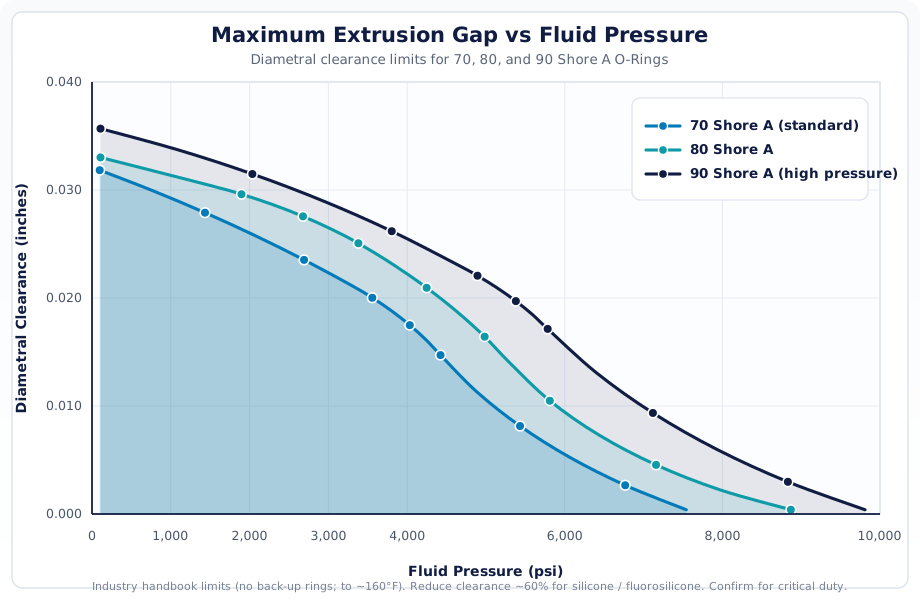
Approximate maximum total diametral clearance (inches) read from those curves:
| Shore A | 500 psi | 1,000 | 1,500 | 2,000 | 3,000 | 5,000 | 8,000 |
|---|---|---|---|---|---|---|---|
| 70 | 0.031 | 0.029 | 0.028 | 0.026 | 0.022 | 0.011 | ~0 |
| 80 | 0.032 | 0.031 | 0.030 | 0.029 | 0.027 | 0.016 | 0.002 |
| 90 | 0.035 | 0.034 | 0.033 | 0.032 | 0.029 | 0.022 | 0.006 |
Reduce the clearance shown by about 60% when using silicone or fluorosilicone. Include cylinder “breathing” (bore expansion under pressure) in the gap you check. Apply a safety factor for sharp edges, higher temperature, and dynamic service.
Rule of thumb used throughout this handbook: a standard 70-durometer ring in a typical industrial gap starts to need help past roughly 1,500 psi. Options are tighten the gap, step to 80 or 90 Shore A, add a back-up ring, or combine those moves. See also Failure Analysis and Rules of Thumb.
Rough application bands
| Shore A | Typical pressure band (guide only) | Notes |
|---|---|---|
| 40–50 | Low | Soft static seals; not for high pressure |
| 60–70 | Up to ~800–1,500 psi with a tight gap | Standard seals |
| 80–90 | Higher pressure / larger gap | Hydraulics, boss ports, extrusion-limited glands |
| 95+ | Specialty | Confirm with application engineering |
Exact limits depend on gap, temperature, fluid swell, dynamic motion, and whether a back-up ring is present. Treat charts as selection guides, then confirm against the controlling drawing and compound datasheet.
How hardness is measured
Hardness comes from the depth of indentation under a standard indentor and force sequence. Shore A uses the familiar spring-loaded durometer foot; IRHD uses a rigid ball indentor. Results depend on:
- Specimen thickness (use the specified thickness when testing)
- Dwell time before the reading
- Surface condition and temperature
- Compound stress-relaxation behavior
Shop-floor durometer checks on a finished O-Ring are useful for screening, not for rejecting a lot to a half-point. Specs are written in bands for a reason.
Picking a durometer (short path)
- Start with 70 Shore A in the compound family your fluid and temperature allow.
- If pressure and gap sit above the 70-duro curve, step to 80 or 90 Shore A and/or add a back-up ring.
- If the joint is low-load or the surface is rough, a softer grade (50–60) can seal where 90 will not, at the cost of extrusion margin.
- For SAE J1926 ORB ports and similar boss seals, catalogs expect 90 Shore A boss stock, not a soft general-purpose ring. See SAE J1926 ORB Boss O-Rings.
When the print already calls a durometer, match it. When it only calls a polymer, 70 is the safe default unless pressure, gap, or a boss/port standard says otherwise.
Related handbook pages
Information within is believed to be accurate and reliable. However, The O-Ring Store, LLC makes no warranty, expressed or implied, that parts supplied will perform satisfactorily in every application. Evaluate the material for your duty before use.