
O-Ring Seal Types, Profiles & Gland Design
O-Ring profiles, static versus dynamic sealing, and the gland arrangements for piston and rod seals.
The O-Ring is the most common seal profile, but it isn’t the only one, and it isn’t always the best one for a moving joint. This page covers the common ring profiles, when an O-Ring is the right choice versus when to reach for something else, and how the gland around it is arranged.
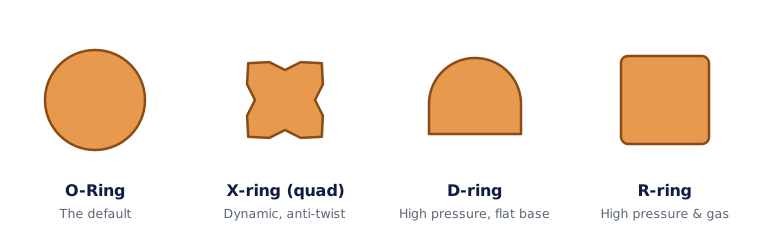
Ring profiles
| Profile | Cross-section | Best for |
|---|---|---|
| O-Ring | Circular (per ISO 3601) | Radial and axial sealing, most static systems. The default. |
| Micro O-Ring | Circular, below ISO 3601 general sizes | The smallest installation spaces. |
| X-ring (quad) | X-shaped | Radial and axial sealing, mainly highly dynamic systems. The twin sealing lips resist rolling and twisting. |
| D-ring | D-shaped (flat base) | Radial static or low-dynamic sealing, high pressure: the flat base resists twisting. |
| R-ring | Rectangular | Radial static sealing, high pressure and gas service. |
| Custom (OR-SF) | Special cross-sections | Application-specific shapes developed to spec. |
Static vs. dynamic sealing
- Static seal: no relative motion between the sealing faces (a face or flange gasket, a cap, a fitting). O-Rings excel here, and the Groove Design guidance applies directly.
- Dynamic seal: the faces move relative to each other (a piston, a rod, a rotating shaft). O-Rings can seal dynamically in slow, short-stroke, or low-frequency service, but movement adds wear, heat, and the risk of twisting (spiral failure). For demanding dynamic duty, an X-ring resists twisting better, and D/R-rings hold up at high pressure.
See Applications for how these land in real piston, rod, and face seals.
Gland types
The gland is the groove plus the mating surface the ring seals against. Two arrangements:
- Axial (face) gland: the ring is squeezed between two flat faces, sealing along its top and bottom. Pressure comes from inside or outside the ring depending on the design.
- Radial gland: the ring sits in a groove on a shaft or in a bore and seals across the gap. A piston seal sits in a groove on the moving part and seals outward against the bore. A rod seal sits in a groove in the housing and seals inward against the rod.
Radial grooves use different depth and width values than an axial (face) gland, and dynamic radial glands demand extra attention to clearance gap, surface finish, and back-up rings. Start with the Groove Design page, then confirm the handling details on Installation. Ask us for the radial groove figures when you’re designing a piston or rod gland.
Profile descriptions: Freudenberg FST 2025 Technical Manual, ch. 6 (Static Seals), §1 (Product Overview), p. 594.