O-Ring Back-Up Rings: Anti-Extrusion Design
When to use O-Ring back-up rings, how they stop extrusion, and single versus double back-up arrangements for high-pressure glands.
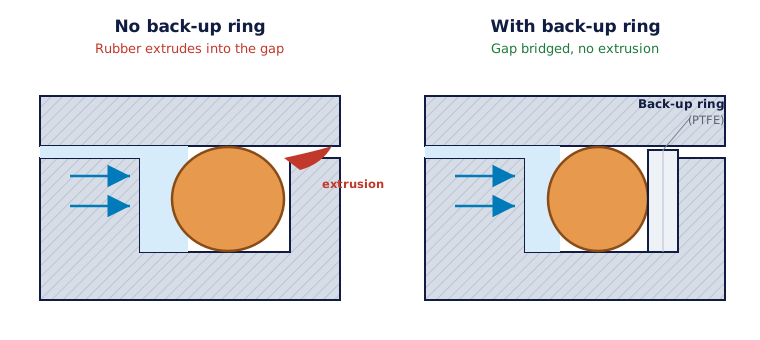
A back-up ring is an anti-extrusion device. It’s a stiffer ring that sits in the groove next to the O-Ring, on the low-pressure side, and bridges the clearance gap so the soft O-Ring can’t be squeezed into it under pressure. When a gland runs high pressure or has a gap it can’t tighten, this is the fix.
What extrusion is, and why the back-up ring stops it
Under pressure the O-Ring is packed against the low-pressure wall of the groove (see Sealing Principles). If the pressure is high enough and the clearance gap is wide enough, the rubber starts flowing into that gap. It nibbles off a ragged edge and eventually fails. That is extrusion.
A back-up ring made of a harder, higher-strength material fills that gap. The O-Ring still does the sealing, but it now presses against the solid back-up ring instead of an open gap, so it has nowhere to extrude. The seal holds at far higher pressure.
When you need one
Reach for a back-up ring when:
- Pressure is high. As a rough guide, a standard 70-durometer O-Ring starts to extrude past about 1,500 psi with a typical gap. Add a back-up ring and you extend well past that, into the several-thousand-psi range.
- The clearance gap is large or can’t be held tight because of tolerances, thermal growth, or side load on the hardware.
- The ring runs hot, since heat softens the rubber and makes it extrude more easily.
- You see nibbled, ragged edges on a failed ring. That is extrusion telling you to add one. See Failure Analysis.
If your gap is small and pressure is moderate, you probably don’t need one. Don’t add parts you don’t need.
Single vs. double
- Single back-up ring: used when pressure acts from one direction only. Put the back-up ring on the low-pressure side, downstream of the O-Ring.
- Double back-up rings: used when pressure can come from either direction, such as a piston that sees pressure on both strokes. Place one back-up ring on each side of the O-Ring.
Either way, the groove has to be wider to make room for the extra ring or rings. Design that width in from the start. See Groove Design.
Materials
Most back-up rings are PTFE (Teflon®), which is tough, low-friction, and chemically near-inert, so it stands up to the same media the O-Ring sees. PTFE back-up rings come as solid (continuous) rings, split (scarf-cut) rings that are easier to install, and spiral rings. Harder elastomers and other engineered plastics are also used in specific duties.
We stock PTFE back-up rings in inch and metric sizes. Tell us your ring size and pressure and we’ll match the right back-up ring to your gland.
Anti-extrusion guidance based in part on the Freudenberg FST 2025 Technical Manual, ch. 6 (Static Seals), §14 Back-Up Rings. We stock PTFE back-up rings in AS568 sizes; see also PTFE for the material itself.