O-Ring Applications: Face, Rod, Piston & Rotary Seals
Where O-Rings seal in real equipment: face and flange seals, rod and piston seals, rotary seals, and the design notes for each.
O-Rings show up in nearly every machine that holds a fluid or a gas. They fall into a few basic arrangements, and knowing which one you’re designing tells you how to lay out the gland and what to watch for.
Static seals
Nothing moves. These are the easiest and most reliable O-Ring jobs, and most seals in the world are static.
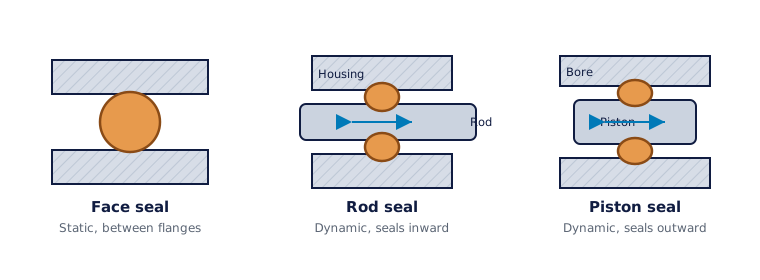
- Face (axial) seals: the ring is trapped between two flat faces, like a flange, a cover plate, or a pipe fitting, and squeezed top to bottom. Design to the axial squeeze on the Groove Design page.
- Radial static seals: the ring sits in a groove on a plug, cap, or fitting and seals across a bore that doesn’t move. Think tube fittings and threaded ports.
Static duty is where silicone, PTFE, and the harder-to-move compounds shine, because wear and friction aren’t in play. See Materials.
Dynamic seals
The faces move against each other. Motion adds friction, heat, and wear, so these glands run lower squeeze, need a finer surface finish, and care a lot more about lubrication.
- Rod (shaft) seals: the O-Ring sits in a groove in the housing and seals inward against a rod that slides through it. Common in hydraulic and pneumatic cylinders.
- Piston seals: the O-Ring sits in a groove on the moving piston and seals outward against the bore wall. Also everywhere in cylinders and actuators.
- Rotary seals: the shaft turns rather than slides. These run the lowest squeeze of all to keep heat down, and for hard duty a dedicated rotary seal or an X-ring often beats a plain O-Ring.
For reciprocating and rotary duty, watch for spiral twisting and abrasion, and consider an X-ring for its twist resistance. See Seal Types & Profiles.
Common industries and duties
O-Rings from our shelves go into hydraulics and pneumatics, pumps and compressors, automotive and off-highway equipment, food and beverage and medical gear, aerospace and defense, oil and gas, semiconductor and chemical process, and plain plumbing and irrigation. The right compound depends entirely on the fluid and the temperature, so once you know the arrangement, take it to the Materials guide and the Chemical Compatibility chart.
Not sure which arrangement you have or which compound fits? Send us the application and we’ll help you spec it.
Application practice based in part on the Freudenberg FST 2025 Technical Manual, ch. 3 (Rotary), ch. 4 and 5 (Fluid Power: Hydraulics and Pneumatics), and ch. 6 (Static Seals). Match the compound to the fluid on the Chemical Compatibility page.