O-Ring Failure Mode Gallery: Picture, Cause, Fix
Every common O-Ring failure mode with a diagram, the root cause, and the fix: extrusion, compression set, swell, heat cracking, explosive decompression, abrasion, spiral failure, installation damage, and ozone cracking.
Nine failures account for nearly every dead O-Ring that lands on our counter. Each one leaves a signature you can read. Match your part to the picture, get the cause, apply the fix. If you would rather start from the symptom (leak, weep, blowout) and work backward, use the Troubleshooting flow.
Extrusion and nibbling
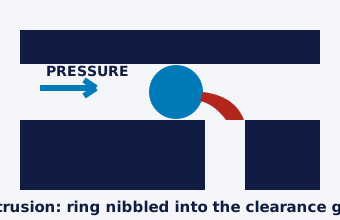
- Looks like: a ragged, nibbled edge or a thin “flag” of rubber on the low-pressure side.
- Cause: system pressure forcing the ring into a clearance gap that is too wide for the compound hardness, or a ring softened by heat or swell. Standard 70-duro rings start extruding around 1,500 psi with typical gaps.
- Fix: tighten the clearance gap, step up to 90 durometer (Buna 90, Viton® 90), or add a back-up ring (PTFE back-ups in stock).
Compression set
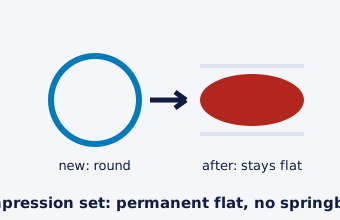
- Looks like: flat-sided cross-section that stays flat when removed; the ring has taken the shape of the gland.
- Cause: heat beyond the compound’s rating, over-squeeze, or a low-grade compound. Time at temperature does the damage; the seal quits when the rubber stops pushing back.
- Fix: move up the temperature ladder (FKM, Aflas®, FFKM), correct the squeeze per Groove Design, and buy quality compounds with verified cure dates.
Chemical swell or shrink
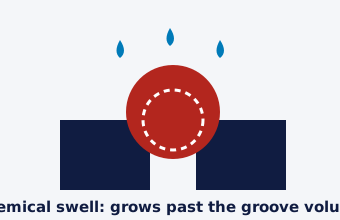
- Looks like: a soft, gummy, oversized ring that no longer fits its groove, or a shrunken, hardened one; either way the fluid attacked the polymer or extracted its plasticizers.
- Cause: compound and fluid do not match. EPDM in petroleum oil and nitrile in brake fluid are the two classics we see weekly.
- Fix: re-select against the Chemical Compatibility matrix, or send us the fluid and temperature and we will match a compound (contact).
Heat hardening and cracking
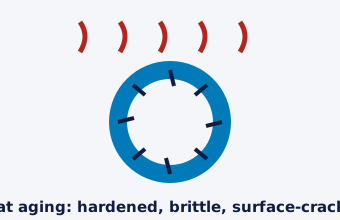
- Looks like: a brittle, shiny, hardened ring with surface cracks, sometimes charred. Bends without springback, snaps instead of stretching.
- Cause: service above the compound’s continuous rating; oxidation accelerates it.
- Fix: check the real gland temperature against the Materials guide ranges and move up: HNBR to +300°F, FKM to +400°F, FFKM beyond +600°F by grade.
Explosive decompression (RGD)
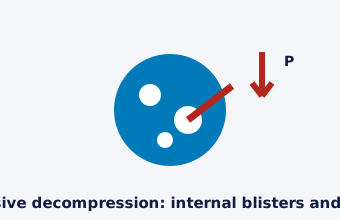
- Looks like: blisters, pits, or internal splits that show up after a rapid depressurization in gas service; the ring can look shredded from the inside out.
- Cause: high-pressure gas dissolves into the elastomer; drop the pressure fast and the gas expands before it can diffuse out.
- Fix: slow the decompression where possible, and run an RGD-rated 90-duro compound: Simriz® 134 (NORSOK M-710 certified), Simriz® 502, or Aflas® and HNBR grades for sour gas. See FFKM for the lineup.
Abrasion and wear
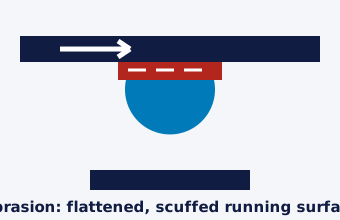
- Looks like: a flattened, scuffed, dull running surface on one side of the ring, in dynamic service.
- Cause: rough counterface finish, no lubrication, or a compound too soft for the duty.
- Fix: correct the surface finish per Groove Design, lubricate (FN Lube), and consider polyurethane, the abrasion champion, or an X-Ring that carries lubricant between its lobes.
Spiral failure
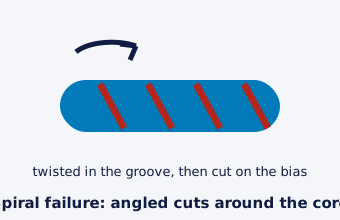
- Looks like: angled or corkscrew cuts running around the cord, as if the ring was sliced on the bias.
- Cause: the ring rolled or twisted in the groove during a reciprocating stroke: one side grips, the other slides. Long strokes, slow speeds, and uneven glands promote it.
- Fix: never roll a ring on during installation, lubricate, reduce gland eccentricity, or switch to a four-lobed X-Ring / quad-ring that resists twisting by design.
Installation damage
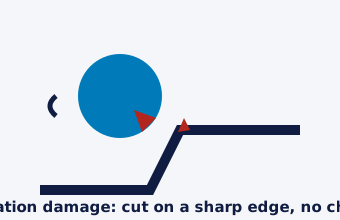
- Looks like: clean fresh cuts, nicks, or skives, often at one spot, on a seal that failed immediately or shortly after assembly.
- Cause: dragging the ring over sharp threads, port edges, or splines without protection, no lead-in chamfer, or a dry install.
- Fix: the entire Installation & Handling page exists for this: chamfer, deburr, lubricate, cover threads, and never force a cold stiff ring.
Ozone and weather cracking
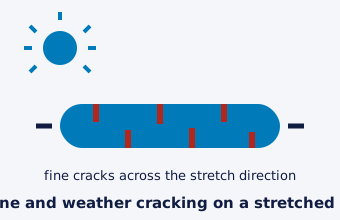
- Looks like: many fine, parallel surface cracks running across the direction of stretch, on rings exposed to air, sunlight, or electrical equipment; “elephant skin” crazing under UV.
- Cause: ozone attacks the double bonds in diene rubbers (Nitrile, natural rubber, SBR) wherever the surface is under strain. Electric motors and sunlight are the usual ozone sources.
- Fix: for outdoor and ozone service use EPDM, Silicone, FKM, or HNBR, and store spares correctly per Storage & Shelf Life.
Still not sure which one killed your seal? Work the root-cause troubleshooting flow, or send us photos of the failed part with the fluid, temperature, and pressure, and we will read it with you.
Failure mechanisms based in part on the Freudenberg FST 2025 Technical Manual, ch. 2 §9 (Damage Analysis), pp. 163-177, and two decades of failed parts across our counter.